
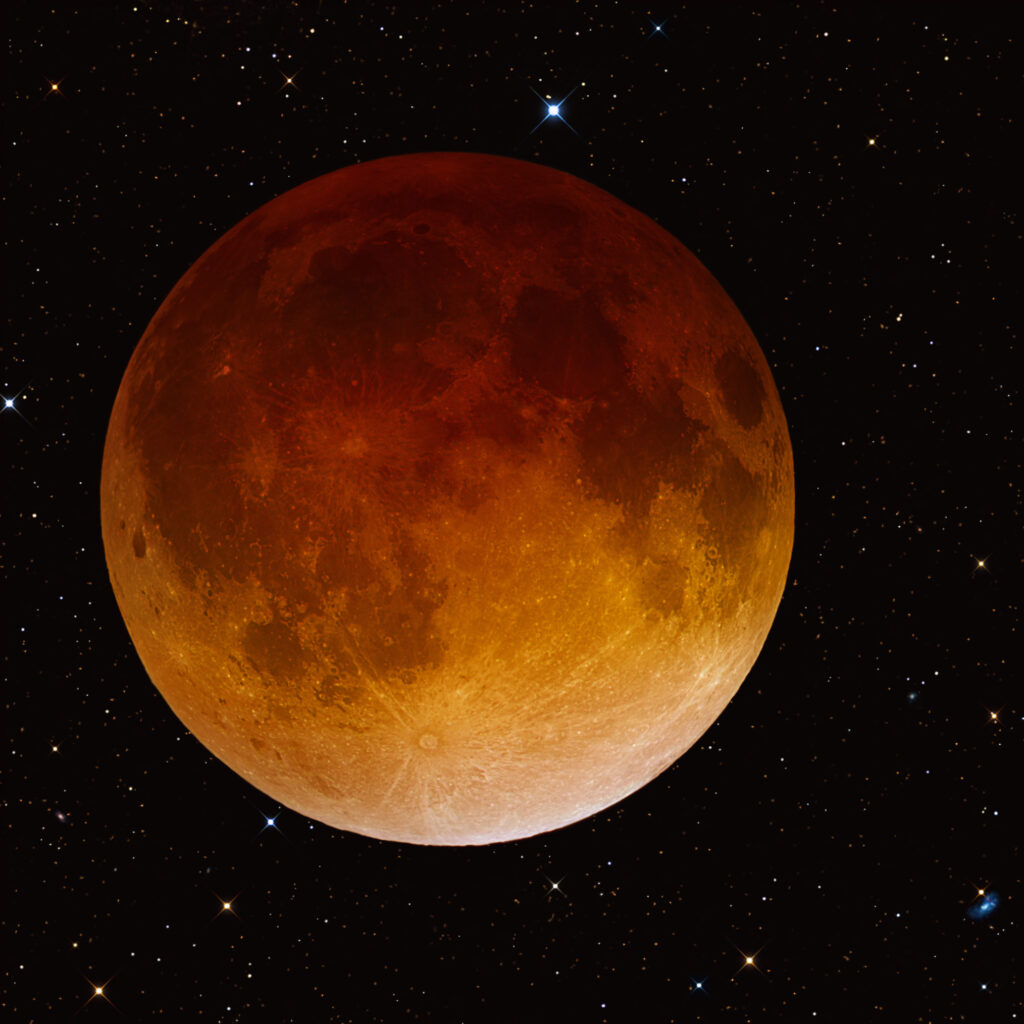
During the early hours of the day, observers in North and South America are witnessing a total lunar eclipse, a phenomenon that turns the Moon a deep reddish color often dubbed a “blood moon.” The event occurs as the Moon moves through Earth’s shadow, specifically the darkest central region known as the umbra, which filters sunlight and imparts the characteristic hue. The geometry behind the eclipse is a straightforward yet precise alignment of the Sun, Earth and Moon. When the Moon’s orbital plane lines up closely with Earth and the Sun, the Earth blocks direct sunlight from reaching the Moon.
The exact type and duration of the eclipse depend on how near the Moon is to a lunar node—the points where the Moon’s orbit intersects the ecliptic plane of Earth’s orbit. Astronomers monitor these nodes to forecast when eclipses will happen and to predict their visibility.
Unlike solar eclipses, which are brief and require protective eyewear, a lunar eclipse can be observed safely from any location on the night side of the planet. This accessibility makes the event popular among both casual sky‑watchers and seasoned astronomers, who can watch the Moon transition from its normal brightness to a rich orange‑red as the eclipse reaches totality. The total phase can endure for an hour or more, offering ample time for visual appreciation and scientific measurement.
For researchers, the eclipse provides a natural laboratory to study Earth’s atmosphere. As sunlight passes through the atmosphere before reaching the Moon, certain wavelengths are scattered, while others are bent into the umbra.
By analyzing the color and intensity of the Moon’s illumination during totality, scientists can infer properties of atmospheric composition and the way Earth’s air interacts with solar radiation. Such data contribute to broader climate research and improve understanding of how celestial events influence planetary conditions. The March 14, 2025 total lunar eclipse underscores the role of modern technology in expanding our grasp of these celestial mechanics.
High‑resolution telescopes, advanced imaging sensors, and sophisticated computer models now allow researchers to track the eclipse’s progress with unprecedented detail. These tools not only enhance public outreach—providing live streams and real‑time data for enthusiasts—but also deepen scientific inquiry into the Earth‑Moon‑Sun system.
Throughout the Western Hemisphere, the eclipse has drawn attention on social platforms and local gatherings, with observers sharing photographs and commentary under hashtags such as #BloodMoonLunar and #EclipseWowsWestern. The widespread visibility and the safety of viewing without special equipment have turned the event into a communal experience, echoing centuries of human fascination with the night sky. As the Moon completes its passage through Earth’s shadow, the temporary “blood moon” will fade back to its usual silvery glow, marking the end of a celestial show that blends visual splendor with scientific opportunity.
The eclipse serves as a reminder of the intricate dance of our solar system’s bodies and the continual advancements that enable us to study these motions with ever‑growing precision. Looking ahead, the tools that have illuminated today’s eclipse—powerful ground‑based observatories, space‑borne instruments, and detailed simulations—promise to reveal even more about the dynamics of our planetary neighborhood.
Each eclipse, whether partial or total, adds a chapter to humanity’s ongoing exploration of the cosmos, reinforcing the connection between observable wonder and the pursuit of knowledge.




