
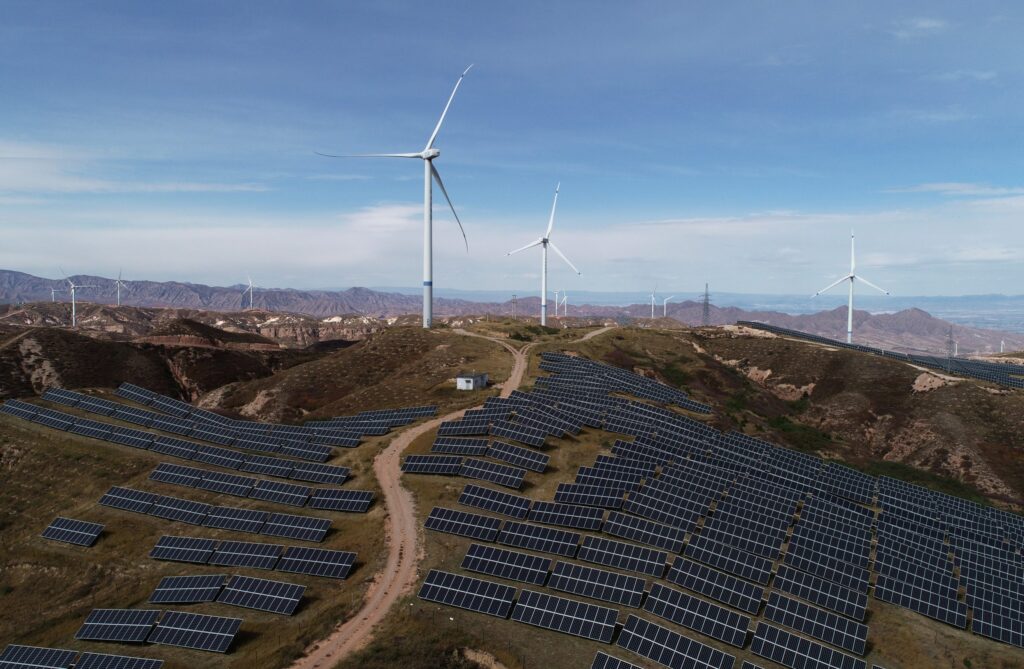
Here is a number that would have sounded absurd a decade ago: 73 gigawatts. That is how far China’s clean power capacity now sits ahead of its fossil fuel capacity. Data from Global Energy Monitor, cited in a Reuters column by Gavin Maguire, put clean sources at 1,494 GW in 2025 against 1,420 GW for coal, gas and other fossil fuels. It was the first year the clean side led.
What the lead looks like
The gap tipped clean power to 51% of the country’s power fleet. China now sits alongside Brazil, France and Germany, big economies that run mostly on clean power. The United States, by contrast, had 233 GW more fossil capacity than clean in operation in 2025, a bigger surplus than any other nation.
China’s own grid regulator tells a similar story with a narrower measure. The National Energy Administration reported that wind and solar alone reached 1,840 GW by the end of 2025, just over 47% of the total. Solar rose 35% to 1,200 GW and wind climbed 23% to 640 GW. Wind and solar first passed thermal power in the first quarter of 2025, at 1,482 GW against 1,451 GW. By December the gap was about 300 GW, with thermal at 1,539 GW. The country added 434 GW of wind and solar in 2025, up from 360 GW the year before.
Why solar did the heavy lifting
How it works is simple enough. Utility-scale solar capacity grew by 1,554% between 2015 and 2025. Solar farms made up a record 18.3% of China’s operating capacity last year, from 2.4% in 2015. That build-out let coal-fired power’s share of generation slide from 64% in 2015 to a record low of 42.7%. Over those ten years total clean capacity expanded by 253% and fossil capacity by 50%, which together lifted total capacity by 113%.
Maguire expects batteries to speed things up. China’s battery industry can store surplus daytime solar power for release at demand peaks.
Capacity is not the same as electricity
Caution is built into the figures. Capacity measures what could be generated, not what is. Speaking on a Harvard Kennedy School panel, MIT Sloan professor Yasheng Huang noted that China still generates 60 percent of its power from coal. “We see addition, not transition,” he said. “China is building alternative sources of energy as well as fossil energy sources, simultaneously.” He added that security interests may help explain why Beijing backs renewables at all.
Reuters makes a point of its own about direction. As the Trump administration cuts federal support for renewables and backs more gas and coal, the column expects the U.S. to widen its fossil fuel lead.
Sources
- China's epic renewables boom lifts it into rare clean capacity club (Reuters column by Gavin Maguire, via Hydrocarbon Processing)
- China's Wind, Solar Power Installed Capacity Exceeded 1,800 GW for First Time in 2025 (Yicai Global)
- Yes, China has embraced renewables – but don't call it a transition, expert says (Harvard Gazette)




