
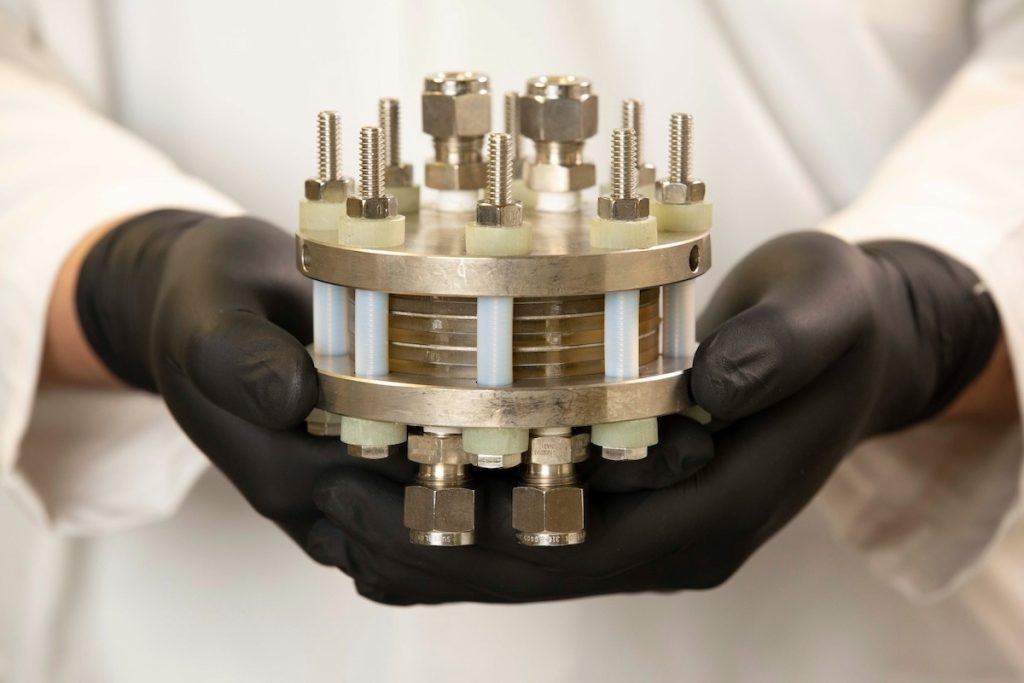
A joint team from the University of Kansas and the U.S. Department of Energy’s Brookhaven National Laboratory has demonstrated a way to generate pure hydrogen without using fossil‑based feedstocks. The findings, published in the Proceedings of the National Academy of Sciences on 5 June 2023, describe a catalytic route that avoids carbon‑producing processes such as natural‑gas reforming.
Catalyst at the heart of the breakthrough
The study centers on a catalyst built from a pentamethylcyclopentadienyl rhodium complex, abbreviated as [Cp*Rh]. This rare‑metal assembly exhibits properties that enable highly efficient hydrogen‑forming reactions.
Earlier attempts at clean hydrogen production often suffered from low efficiency or relied on costly materials that limited large‑scale use. By contrast, the [Cp*Rh] complex proved capable of driving the needed chemical transformations with minimal energy input and without rapid degradation.
Laboratory insights and industrial relevance
James Blakemore, associate professor of chemistry at the University of Kansas, led the investigation into the catalyst’s behavior. His group applied advanced spectroscopic techniques to monitor atomic‑level interactions during hydrogen evolution.
The data confirmed that the catalyst operates as intended and remains stable under reaction conditions, supporting the notion that the process could be adapted to existing industrial infrastructure with only modest modifications.
Potential beyond hydrogen generation
According to the researchers, the principles demonstrated by the [Cp*Rh] system may be transferable to other chemical challenges. Blakemore suggested that similar catalyst designs could aid in recycling nuclear fuels or handling actinide elements found in spent nuclear material, thereby improving safety and reducing long‑term storage concerns.
The versatility of the rhodium complex also hints at applications in pharmaceutical synthesis and environmental remediation, expanding the impact of the discovery beyond energy production.
Training the next generation of scientists
The project served as a practical training platform for several university students who performed the experiments and operated high‑resolution analytical equipment. Participation gave them hands‑on experience with cutting‑edge catalytic systems, strengthening their qualifications for future roles in academia or industry. The mentorship model employed by Blakemore and his colleagues highlighted how large‑scale research can simultaneously advance scientific knowledge and develop skilled young professionals.
Implications for sustainable energy infrastructure
Demonstrating a fossil‑free route to hydrogen marks a significant milestone for clean‑energy initiatives. By providing a scalable, low‑carbon alternative to conventional hydrogen production, the method addresses a key obstacle to decarbonizing transportation and industrial processes while preserving energy security.
The peer‑reviewed publication ensures that the results have undergone rigorous scrutiny, paving the way for other groups to replicate and build upon the work.
Looking ahead
Continued investment will be essential to move the technology from laboratory proof‑of‑concept to commercial deployment. If successfully scaled, the [Cp*Rh]‑based process could become a cornerstone of a greener hydrogen economy, supporting global climate targets and demonstrating the value of collaborative research between academic institutions and federal laboratories.




