
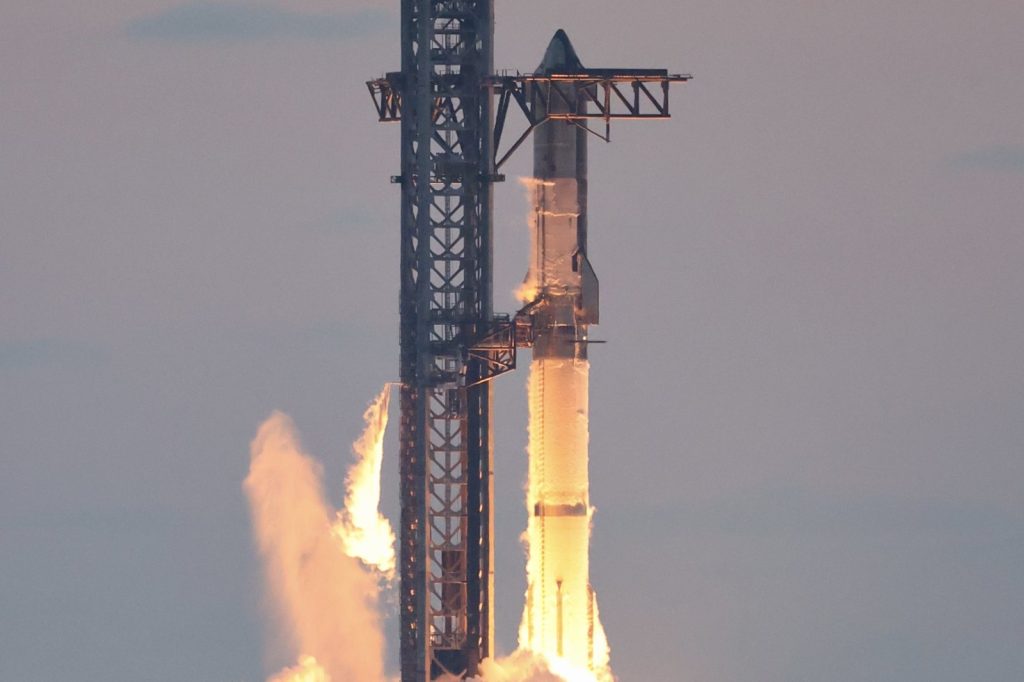
SpaceX’s Starship development program suffered a major setback on June 18, 2025, when a vehicle designated Starship 36 exploded during a static fire test at the company’s Texas facility. The incident occurred while the spacecraft was secured to the test pad, with its engines firing at full thrust for several seconds as part of a final pre-flight check. The explosion damaged the test facility and destroyed the vehicle, marking a significant disruption in the program’s development timeline.
This failure adds to what has become a challenging record for the Starship program. Since the first integrated flight test in April 2023, SpaceX has conducted 11 launches.
Of those, six have been classified as successes and five as failures. The static fire explosion on June 18 effectively raises the failure count to six, further reducing the program’s overall success rate to just above 50 percent. The Starship system is designed as a fully reusable launch vehicle, consisting of two stages: the Super Heavy booster and the Starship spacecraft itself. Both components are intended to be recovered and reused multiple times, a strategy aimed at dramatically reducing launch costs and increasing flight frequency.
This approach, however, depends on the vehicles surviving all phases of testing and operation. Starship 36 did not survive its static fire test.
SpaceX has been developing three distinct vehicle versions: Block 1, Block 2, and Block 3. Each iteration is intended to address shortcomings identified in previous versions and move closer to a mass-manufacturing capability suitable for a wide range of missions. Starship 36 was part of this iterative design process, representing either a Block 2 or Block 3 configuration.
Its destruction suggests that the development pipeline still faces significant challenges. The company’s long-term goal remains the establishment of a human settlement on Mars, a vision that has driven the program since its inception.
Despite the setbacks, SpaceX continues to build and test new vehicles. Each failure provides engineering data that informs future designs, but each also consumes time and financial resources, potentially pushing the Mars timeline further into the future. The incident raises questions for commercial and government customers who require reliable launch services for their payloads.
A vehicle that explodes during a pre-flight test does not inspire confidence among insurers, regulators, or potential clients. SpaceX has the financial resources and organizational will to absorb these losses and continue development.
The immediate path forward involves identifying the root cause of the failure, implementing fixes, and resuming testing. For now, the program’s record stands at 11 launches, six successes, five failures, and one static fire explosion. The goal of Mars colonization remains unchanged, but the journey has become more difficult.




