
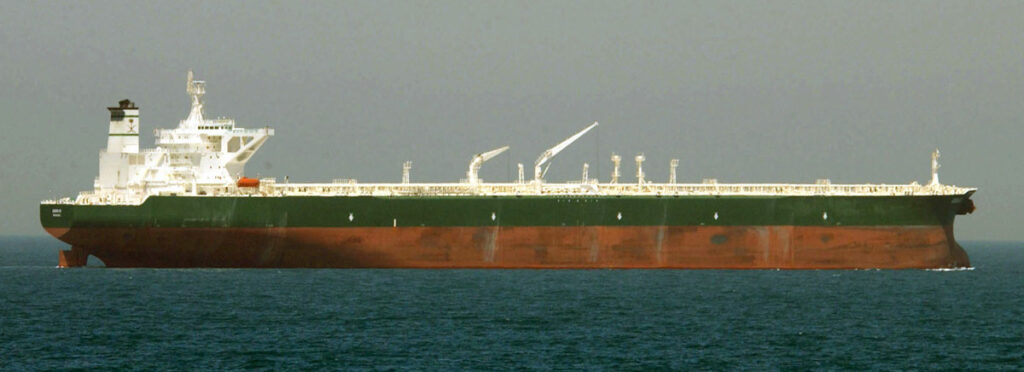
WASHINGTON, July 12 — The U.S. Energy Information Administration’s latest assessment of the Strait of Hormuz places a stark number on the table: 17 million barrels per day of oil and petroleum products transited the waterway in 2023. That figure represents roughly 20 percent of global consumption, according to the EIA’s data. The strait measures approximately 33 kilometers, or 21 miles, at its narrowest point.
Two shipping lanes, each two miles wide, handle inbound and outbound traffic. The depth ranges from 30 to 100 meters, or 98 to 328 feet, sufficient for supertankers.
These are the physical facts of a chokepoint that carries crude oil and refined products from the world’s largest producing region.
The flow of exports
On the timeline of 2023, the EIA recorded that roughly 14 million barrels per day of crude oil passed through the strait, along with about 3 million barrels per day of refined petroleum products. The major exporters are Saudi Arabia, which shipped over 6 million barrels per day; Iraq, at 3.4 million barrels per day; Kuwait, at 2.5 million barrels per day; and the United Arab Emirates, at 2.8 million barrels per day. Beyond oil, Qatar exports approximately 77 million tons of liquefied natural gas per year through the strait.
These are not theoretical flows. They are the recorded volumes that move through a passage less than 21 miles wide at its tightest point.
Any disruption to that traffic would affect global supply chains directly.
Price shock and strategic reserves
The EIA estimates that a full closure of the Strait of Hormuz could increase global oil prices by 30 to 50 percent in the short term. That is the agency’s modeled projection, based on the volume of supply that would be removed from the market. The United States maintains the Strategic Petroleum Reserve, which held about 375 million barrels as of 2025.
The International Energy Agency requires its member nations to hold oil reserves equivalent to 90 days of net imports. These reserves exist precisely for scenarios like a strait closure, but they are finite buffers against a sustained supply shock.
Alternative pipeline routes exist. Saudi Arabia’s East-West Pipeline, for example, has a capacity of about 5 million barrels per day. That pipeline bypasses the strait, but its capacity does not match the volume that flows through the waterway.
The math is straightforward: the strait carries more than three times what the East-West Pipeline can handle.
What to watch next
The EIA’s data provides a baseline for understanding the stakes. The record shows that 17 million barrels per day and 77 million tons of LNG per year depend on a passage 33 kilometers wide. The question for markets and policymakers is not whether the strait is critical — the numbers settle that — but what happens if the assumptions behind those numbers change.




