
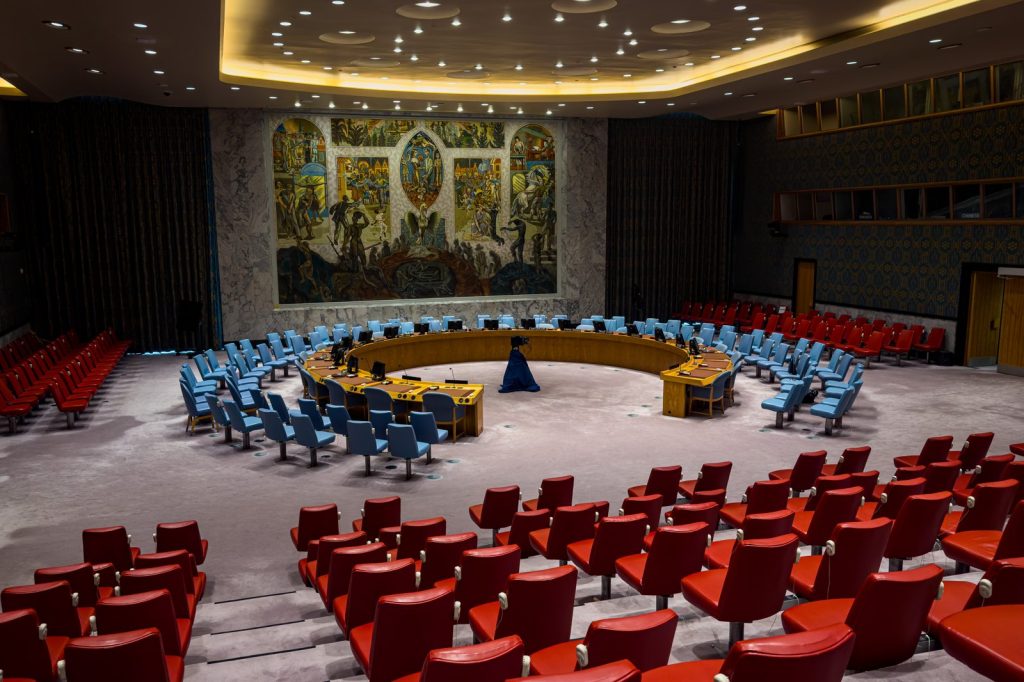
WASHINGTON, July 8 — The United Nations Security Council is poised to meet under Resolution 2789, the framework that endorsed the now-collapsed ceasefire with Iran, following President Trump’s March 30 declaration that the truce is “over.” The diplomatic rupture leaves the Persian Gulf region bracing for a range of escalating scenarios, from increased U.S. naval deployments to renewed Iranian strikes on oil infrastructure. The ceasefire, which Resolution 2789 had formally endorsed, unravelled after President Trump’s statement.
With no talks currently scheduled, diplomatic efforts by Oman and Qatar to restart negotiations remain stalled. The Security Council session will confront the question of how to respond to a ceasefire that no longer exists.
Behind the breakdown lies a cascade of military and economic risks. The United States may increase its military presence in the Persian Gulf, including the deployment of additional carrier strike groups. Iran, for its part, could resume attacks on oil tankers or Saudi infrastructure — a pattern last seen on September 14, 2019, when the Abqaiq-Khurais attack temporarily cut 5.7 million barrels per day of Saudi production.
That single strike jolted global energy markets and demonstrated the vulnerability of the region’s oil heartland.
Nuclear clock ticking
For families and policymakers alike, what this means for regional stability is shaped by Iran’s accelerating nuclear program. According to the International Atomic Energy Agency, Iran is enriching uranium at 60 percent purity — a short technical step from the 90 percent weapons-grade threshold. The IAEA has assessed that Iran could cross that line within weeks if it chose to.
The timing is particularly fraught. The U.S. retains the option to reimpose “snapback” sanctions under UN Security Council Resolution 2231, the 2015 framework that limited Iran’s nuclear activities in exchange for sanctions relief.
The United States claimed this snapback right in 2020, though the legal mechanism remains contested among other Security Council members. Reimposing those sanctions would effectively restore the full pressure campaign that preceded the 2015 nuclear deal. The Strait of Hormuz, through which about a fifth of the world’s petroleum passes, remains the flashpoint.
A 2024 analysis by the International Energy Agency projected that oil prices could spike to $100 per barrel if the strait is disrupted. The U.S. Strategic Petroleum Reserve release could moderate those price increases, but the scale of any disruption would determine how effective that buffer proves.
OPEC+ meets amid uncertainty
OPEC+ is scheduled to meet on April 5 to discuss production levels, a gathering that will take place against the backdrop of a fractured ceasefire and the threat of supply disruptions. The cartel’s decisions on output could either cushion or amplify the price shocks that analysts now anticipate. The human side of this story reaches far beyond the negotiating table.
For families across the Middle East, the collapse of the ceasefire means a return to the uncertainty of a region where military escalation can upend daily life. For patients in Iran, where sanctions have historically restricted access to medical supplies and pharmaceuticals, the prospect of renewed snapback sanctions carries concrete consequences.
Behind the breakthrough of the original ceasefire now lies the question of whether diplomacy can be revived before the next crisis.
{“@context”: “https://schema.org”, “@type”: “NewsArticle”, “headline”: “U.S.-Iran Conflict Scenarios: Potential Impacts on Oil Markets”, “description”: “WASHINGTON, July 8 — The United Nations Security Council is poised to meet under Resolution 2789, the framework that endorsed the now-collapsed ceasefire with Iran,…”, “datePublished”: “2026-07-08T09:30:00+00:00”, “author”: {“@type”: “Person”, “name”: “James Roberto”}, “publisher”: {“@type”: “Organization”, “name”: “InfoPulse Today”, “url”: “https://newsfeed.infopulsetoday.com/”}}




