
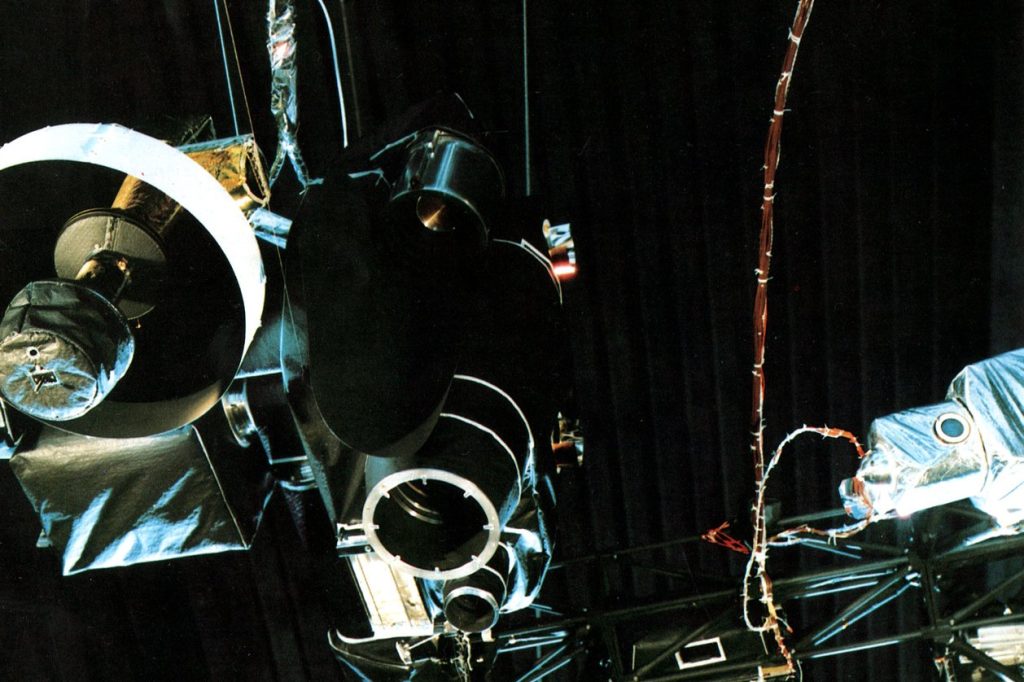
PASADENA, July 9 — The two Voyager spacecraft, launched from Earth in the late summer of 1977, remain the only human-made objects to have crossed the boundary of our solar system and entered the vast, unknown realm of interstellar space. For nearly five decades, these probes, built by NASA’s Jet Propulsion Laboratory, have been sending back data from a region no other machine has reached. Voyager 1 was the first to make the crossing.
It was launched on September 5, 1977, and passed through the heliopause—the edge of the Sun’s influence—in August 2012. At that moment, it was about 121 AU from the Sun.
One AU is the distance from Earth to the Sun. Voyager 2, which launched a few weeks earlier on August 20, 1977, followed suit, crossing the same boundary in November 2018 at a distance of about 119 AU. The early findings from both spacecraft were striking.
Their instruments detected a sharp increase in cosmic rays and a simultaneous drop in solar particles at the boundary. This was the clearest evidence that the probes had left the bubble of our Sun’s magnetic field and entered the interstellar medium—the material that fills the space between stars.
Two different paths, one historic achievement
The two spacecraft were not identical in their instrument suites. Voyager 1’s plasma wave instrument was damaged, which meant it could not directly confirm the crossing through measurements of the surrounding plasma. Voyager 2, however, carried a working plasma spectrometer that provided the confirming data.
This gave scientists a more complete picture of what happens at the edge of the solar system. Both probes carry a Golden Record—a time capsule of sounds and images from Earth, intended for any intelligent life that might one day find them.
The Voyager missions were designed to be long-lived, but they are not eternal.
Power is running low, but the science continues
The spacecraft are powered by radioisotope thermoelectric generators, or RTGs, which convert the heat from decaying plutonium into electricity. These power sources are slowly weakening. The Voyager missions are expected to continue returning data until about 2025, when the RTGs will no longer be able to power the instruments.
After that, the probes will fall silent, continuing their journey through the galaxy without sending back any more information. As of 2023, Voyager 1 was about 159 AU from Earth, and Voyager 2 was about 133 AU.
The probes are now in interstellar space, studying the interstellar medium—the environment between stars. They are measuring cosmic rays, magnetic fields, and plasma densities that have never been observed directly before. The encouraging part is that even as the power fades, the data keeps coming.
Every new reading from these distant spacecraft adds to our understanding of the space beyond our Sun’s protective bubble. For now, scientists at JPL and around the world continue to monitor the signals, knowing that each transmission could be among the last.
Patients and families who follow space exploration often ask what this means for our understanding of the universe. The answer, for now, is that we are still learning. The Voyager probes have given us a first look at interstellar space, and early findings suggest it is a more complex and dynamic environment than many models predicted.
As always, patients should talk to their doctor if they have specific questions about how space science relates to their health or treatment. But for the broader question of what lies beyond our solar system, we can only wait and watch the data.
{“@context”: “https://schema.org”, “@type”: “NewsArticle”, “headline”: “Voyager 1 and 2 Cross Heliopause, Reveal Cosmic Findings”, “description”: “PASADENA, July 9 — The two Voyager spacecraft, launched from Earth in the late summer of 1977, remain the only human-made objects to have crossed…”, “datePublished”: “2026-07-09T09:30:00+00:00”, “author”: {“@type”: “Person”, “name”: “Muhammad Asim”}, “publisher”: {“@type”: “Organization”, “name”: “InfoPulse Today”, “url”: “https://newsfeed.infopulsetoday.com/”}}




