What is a neutrino anyway? The science behind this year’s Nobel Prize in Physics
The 2026 Nobel Prize in Physics was awarded to Francis Halzen for decisive contributions to the IceCube Neutrino Observatory and the discovery of high-energy neutrinos of astrophysical origin. But what are these ghostly messengers, and why do they matter? A neutrino is an elementary particle that interacts only via the weak interaction and gravity. It carries no electric charge, and its rest mass is so small that for decades physicists believed it to be zero. The particle exists in three leptonic flavors: electron, muon, and tau. Each flavor is associated with a corresponding charged lepton.
For much of the 20th century, the neutrino remained a theoretical curiosity. It was not until 1956 that the particle was finally observed in a laboratory setting, a feat achieved through its extraordinarily rare interactions with matter. The 2026 Nobel recognition builds on a lineage of discovery that began with the confirmation that neutrinos possess mass. Research conducted by the KATRIN collaboration has determined that a neutrino is more than one million times lighter than an electron, with the current upper limit on the sum of neutrino masses sitting at less than 0.120 eV/c². These findings have narrowed the particle’s known properties, yet fundamental questions remain.
The Physics of Oscillation
One of the most significant breakthroughs in neutrino science came with the discovery of oscillation. Experiments have confirmed that neutrinos change “flavor” as they travel through space. An electron neutrino produced in the Sun may arrive on Earth as a muon or tau neutrino. This phenomenon proved that neutrinos must have mass, however tiny. The KATRIN experiment, which uses a massive spectrometer to analyze tritium decay, has set the most precise direct limit on the electron neutrino mass to date. The collaboration’s analysis of 259 days of data placed the mass of the neutrino below 0.45 eV/c². This result is significant because, although each neutrino is exceedingly light, their combined mass plays a fundamental role in shaping the large-scale structure of the universe, influencing how matter clumped together after the Big Bang.
Messengers from the Cosmos
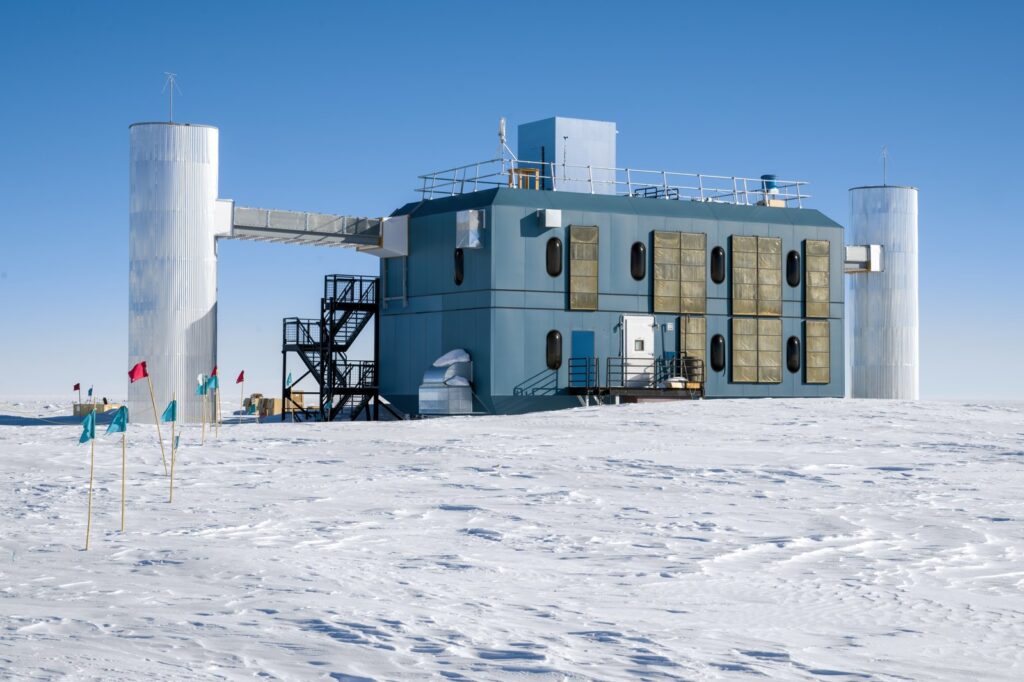
Neutrinos are ideal astrophysical messengers because they travel unimpeded across the universe. Unlike photons, which are scattered by interstellar dust and magnetic fields, neutrinos pass through matter virtually unaffected. This property allows them to carry information from the most violent and dense environments in space, such as the cores of collapsing stars or the accretion disks around black holes, where light cannot escape. The IceCube Neutrino Observatory, embedded in a cubic kilometer of deep ice at the South Pole, has been instrumental in detecting high-energy neutrinos from beyond our galaxy. By capturing the rare interactions of these particles, IceCube has opened a new window onto the high-energy universe, confirming the existence of astrophysical neutrinos from distant sources.
A Cosmic Legacy
Neutrinos are relics of the early universe. They were created in vast numbers during the first second after the Big Bang, and their abundance helped determine the cosmic web of galaxies we see today. Even now, billions of solar neutrinos pass through every square centimeter of Earth’s surface every second, a constant flux generated by nuclear reactions in the Sun’s core. The detection of these particles requires immense infrastructure; IceCube’s thousand-odd sensors are designed to catch the faint flashes of light produced when a neutrino finally interacts with an atom in the ice. As research continues, the effort to pin down the neutrino’s exact mass and to determine whether it is its own antiparticle moves forward, promising further insights into the fundamental nature of reality.
Neutrino Detection and the IceCube Observatory
Detecting neutrinos presents a formidable challenge due to their elusive nature. The IceCube Neutrino Observatory, situated deep within a cubic kilometer of Antarctic ice, employs a vast array of optical sensors designed to capture the faint Cherenkov radiation emitted when a neutrino collides with an atomic nucleus. This method allows scientists to trace the particle’s path and energy. Because neutrinos rarely interact with matter, IceCube’s sheer size is essential; the detector volume must be enormous to register a meaningful number of events from cosmic sources. The observatory has successfully identified high-energy neutrinos originating from outside the Milky Way, providing direct evidence of violent astrophysical processes such as gamma-ray bursts and active galactic nuclei. These discoveries confirm that neutrinos serve as powerful messengers from the most energetic regions of the cosmos.
Beyond the South Pole, solar neutrinos constitute a constant background flux that permeates the Earth. Approximately 65 billion solar neutrinos pass through every square centimeter of the planet’s surface each second. These particles are produced via nuclear fusion in the Sun’s core and provide a unique probe of solar physics. While interactions are infrequent, large-scale experiments utilizing massive tanks of cleaning fluid or other target materials have measured these fluxes with high precision. The study of both high-energy cosmic neutrinos and low-energy solar neutrinos continues to refine models of particle physics and stellar dynamics, reinforcing the particle’s role as a bridge between the subatomic and the celestial.
Neutrino Oscillation and Flavor Change
Neutrinos exhibit a quantum phenomenon known as oscillation, where a neutrino created with a specific flavor—electron, muon, or tau—transforms into another flavor as it travels through space. This transformation occurs because the neutrino’s flavor state is a quantum superposition of three distinct mass states with different values. Since the mass states propagate at slightly different speeds, the relative phase changes over distance, causing the probability of detecting a particular flavor to oscillate. Experimental confirmation that neutrinos possess mass, however tiny, came directly from the observation of this flavor change, proving that the three discrete neutrino masses do not align perfectly with the three defined flavors.
Laboratory experiments have measured the differences between the squares of the three neutrino masses, while cosmological observations have established an upper limit on the sum of all three masses. The KATRIN collaboration, through direct tritium beta-decay spectroscopy, has set the most precise upper limit on the mass of the electron neutrino specifically. Analysis of 259 days of data placed the electron neutrino mass below 0.45 eV/c². Although each individual neutrino is exceedingly light, the collective mass of these particles plays a significant role in cosmology; their gravitational influence helped shape the large-scale structure of the universe during its early evolution, determining how matter clumped together after the Big Bang.
Sources
- Neutrino
- KATRIN Narrows Down the Range of Neutrinos’ Mass
- How neutrinos, which barely exist, just ran off with a Nobel Prize — again!
Photo: Christopher Michel (CC BY-SA 4.0)