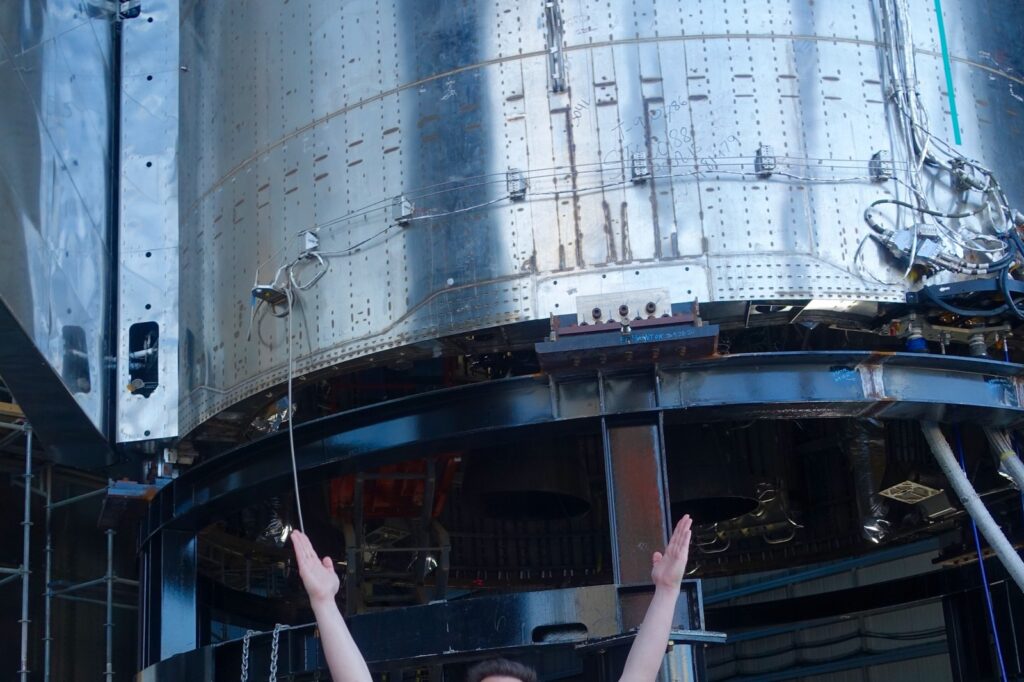
STARBASE, November 8, 2026 — SpaceX is targeting Friday, November 13, for Starship Flight 15, a mission that will attempt the first simultaneous catch of both the Super Heavy booster and the Starship upper stage at the launch tower. The attempt hinges on regulatory approval from the Federal Aviation Administration.
The Mission Profile
Liftoff is scheduled within a 75-minute window opening at 4:45 pm CT from Starbase, Texas, according to SpaceX. The flight will use Booster 22 and Ship 42, both Block 3 vehicles that have completed static fire tests. Ship 42 is expected to reach an altitude of approximately 170 to 171 miles and complete 14 orbits over a planned 22-hour mission, deploying 26 Starlink V3 satellites along the way. Three of those satellites carry cameras to image the ship’s heatshield during reentry.
Flight controllers will only permit the ship to return to Starbase if its status meets internally developed and FAA-approved conditions for a tower catch. If issues arise during the coast phase, the mission can be ended early in pre-cleared areas over the Pacific Ocean near Hawaii and Chile. SpaceX has also prepared to intentionally break up the vehicle over the Gulf of America if systems or the tower at Pad 2 are not ready.
The Harder Catch
SpaceX has caught the Super Heavy booster multiple times, starting with Flight 5 in October 2024 and including Flights 7 and 8. Those catches used the launch tower’s mechanical arms, often called “chopsticks.” The upper stage is a different problem. Returning from orbital velocity requires navigating an intensely challenging reentry trajectory back toward land, pushing guidance, navigation, and thermal protection systems to their limits. The ship will fly over inhabited areas in northern Mexico and southern Texas, passing north of South Padre Island, on its way to the tower.
President and COO Gwynne Shotwell stated that SpaceX expected the Flight 15 license to cover return-to-launch-site tower catches for both stages. Elon Musk noted that if both catches are successful, it will mark the first time all parts of an orbital rocket return to Earth intact.
Why It Matters
Full and rapid reusability of both stages is the foundational economic pillar of the Starship program. Ocean splashdowns subject hardware to saltwater corrosion and prevent rapid turnaround. Catching the ship intact would allow SpaceX to inspect, refurbish, and potentially refly both stages, a step toward airline-like orbital operations. The FAA has issued a NOTAM for possible reentry and splashdown in the Indian Ocean from November 13 to November 20 as a backup if the catch attempt is waived off.
Sources
- Here’s how SpaceX will catch both Starship stages on the rocket's longest mission next week
- SpaceX targets Nov 13 for Starship Flight 15 and first Ship catch
- Starship Flight 15: SpaceX shares launch timing for its most ambitious orbital mission on November 13
- SpaceX targets Nov 13 for Starship Flight 15 and first dual-catch attempt
- SpaceX targets November 2026 for starship flight 15 launch test
Photo: Steve Jurvetson from Los Altos, USA (CC BY 2.0)