
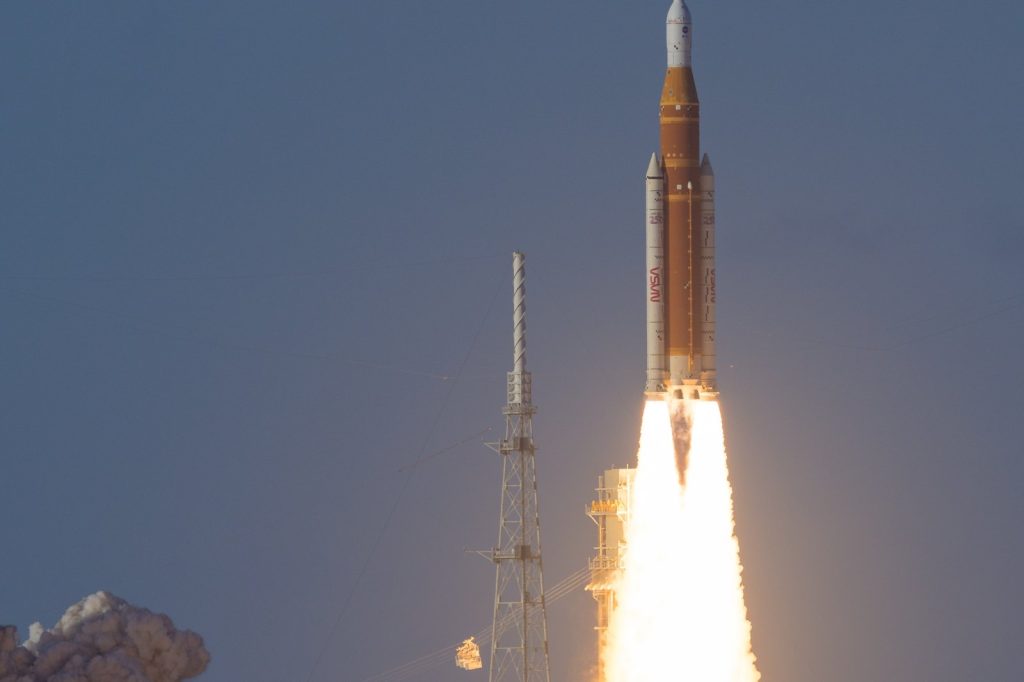
Artemis II Sends Crew on Lunar Flyby Mission
The United States has launched astronauts toward the Moon for the first time in more than fifty years, with the Artemis II mission lifting off from Kennedy Space Center in Florida. The flight marks a significant step in NASA’s Artemis program, which seeks to return humans to the lunar surface, establish a lasting presence there, and later apply the knowledge gained to missions bound for Mars.
Orion spacecraft carried four crew members: Commander Reid Wiseman, Pilot Victor Glover, and mission specialists Christina Koch and Jeremy Hansen, the latter representing the Canadian Space Agency. After liftoff, the vehicle began an approximately ten‑day trajectory that will take it around the Moon and return to Earth. During the early phase of the journey, Orion transmitted vivid images of Earth, offering a fresh perspective on our home planet.
The mission does not involve a lunar landing; that objective is reserved for the later Artemis III flight, currently scheduled for 2028. Instead, Artemis II is designed to evaluate the spacecraft’s life‑support, navigation, and communication systems while a crew is aboard, providing critical data before any attempt to touch down on the Moon.
By testing these systems with humans on board, NASA aims to verify that Orion can sustain astronauts in deep‑space conditions. The information gathered will help engineers refine the vehicle for future landings and for the longer‑duration missions envisioned under the Artemis architecture. Observers along Florida’s coastline watched the launch, underscoring the generational nature of the event.
No astronauts have ventured toward the Moon since the Apollo program concluded in 1972, making this flight a notable milestone in the nation’s space‑flight history. As the spacecraft continues its path around the Moon, it will collect scientific and engineering data that will inform the planning of subsequent Artemis missions.
The focus now shifts to the crew’s activities during the roughly ten‑day flight, including system checks, communications tests, and observations that will validate Orion’s performance. Success in Artemis II will represent a major advance toward NASA’s goal of returning humans to the Moon and, eventually, sending astronauts to Mars. The mission demonstrates the progress made in space‑flight technology and rekindles public excitement about deep‑space exploration.
Looking ahead, the next major milestone is the Artemis III mission, targeted for 2028, which will include a lunar landing. The experience and data acquired from Artemis II will be essential in preparing for that historic touchdown, ensuring that the systems, procedures, and crew readiness are adequate for the challenge.
Overall, the Artemis program continues to push the boundaries of what is possible in space exploration. For NASA and space enthusiasts worldwide, the current flight signals the start of an exciting new era, with each successive mission building on the lessons of the one before it.




