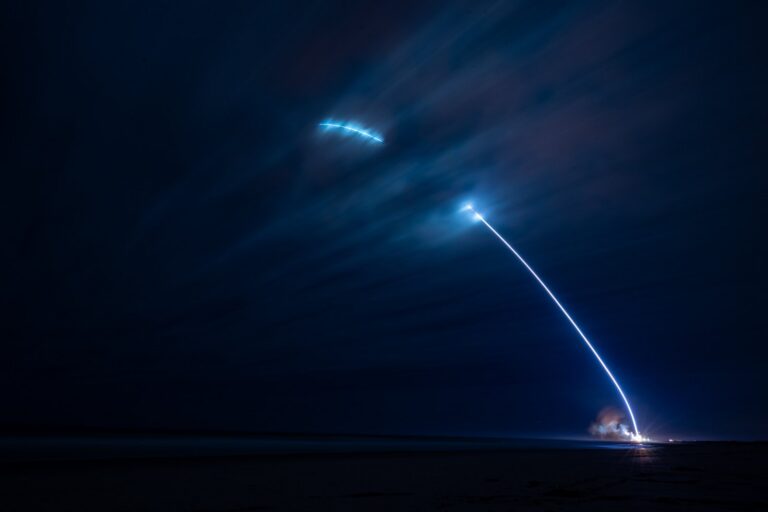
The China National Space Administration (CNSA) this week achieved a controlled recovery of the first stage of its Long March 10B rocket following a test flight, marking a strategically important step toward sustainable, cost-effective access to orbit. The booster stage descended under control and landed as designed, validating a technology that CNSA has long identified as critical to its future space activities. The Long March 10B is a two-stage rocket tailored to launch the Mengtian-class station modules and a new-generation crew spacecraft capable of carrying up to seven astronauts.
Its recoverable first stage directly targets the single largest expense in rocketry: the booster engines and fuel tanks that make up the most costly part of a launch vehicle. Reusing that hardware lowers the price per flight, which matters intensely for a space program that must regularly rotate crews and deliver cargo to a permanent orbital outpost.
Reusability and the Economics of Tiangong
China’s space budget for 2023 was estimated at $12 billion, placing it second behind the United States, whose NASA budget that year was $25 billion. Without reusability, maintaining the Tiangong space station would consume a disproportionate share of that funding, because each crew rotation and resupply mission would require a brand-new first stage. Tiangong became fully operational in November 2022 with the addition of the Mengtian laboratory module.
Since then, the station has hosted rotating crews of three astronauts on missions that typically last about six months. Each rotation demands a fresh Shenzhou spacecraft launch and periodic deliveries via Tianzhou cargo vessels.
The economic pressure of sustaining that cadence makes the recovery test a milestone for CNSA’s long-term planning. Tiangong is the product of a step-by-step approach to developing a permanent manned presence in space. It followed two earlier, smaller stations: Tiangong-1, which provided early docking experience, and Tiangong-2, which tested life-support systems. Assembly of the current modular station began in 2021 with the launch of the Tianhe core module, and the facility reached full operational status the next year.
Although Tiangong is smaller than the International Space Station, it supports international researchers. China is currently training astronauts from Pakistan and Macau to visit the facility.
The station represents a shift from experimental flights to long-term orbital research, with work underway on materials science, space technology, and bioastronautics. This commitment to a continuous human presence in low Earth orbit was built after the United States blocked China from participating in the International Space Station program.
Lunar Ambitions and the International Lunar Research Station
The Long March 10 rocket family includes a variant that serves far more than the station logistics role. The Long March 10Y, a three-stage configuration with two side boosters, is being developed to land Chinese astronauts on the Moon by 2030. Its lift capacity to trans-lunar injection is 27 metric tons.
For its initial missions to the Moon, the 10Y will likely fly in expendable mode, but the reusable first-stage technology being tested on the 10B will almost certainly inform the lunar variant’s design over time. Each successful recovery of the 10B first stage builds confidence—and engineering data—for the teams racing to meet the 2030 crewed lunar landing deadline.
That deadline is tied to a larger project: the International Lunar Research Station (ILRS), a partnership with Russia’s Roscosmos announced in June 2021. CNSA has stated that reusable rockets are essential to its goal of establishing a permanent lunar research station by 2035. The ILRS is China’s answer to the US-led Artemis Accords and the planned Lunar Gateway, representing a rival infrastructure built on the Moon’s surface with a partner that has its own troubled history with spaceflight.
For Beijing, the stakes are high. Without cost-effective launch systems, sustaining such an outpost would be prohibitively expensive.
The recovery test this week was a quiet but critical demonstration that the system works. What to watch next: the pace of testing on the Long March 10Y lunar variant. If China is to meet its 2030 deadline, that rocket must be flight-ready well before then.
The Long March 10B is not simply a rocket; it is the delivery system for China’s next decade in space, responsible for crew rotations, module additions, and eventually the cargo that will sustain a research station on another world.