
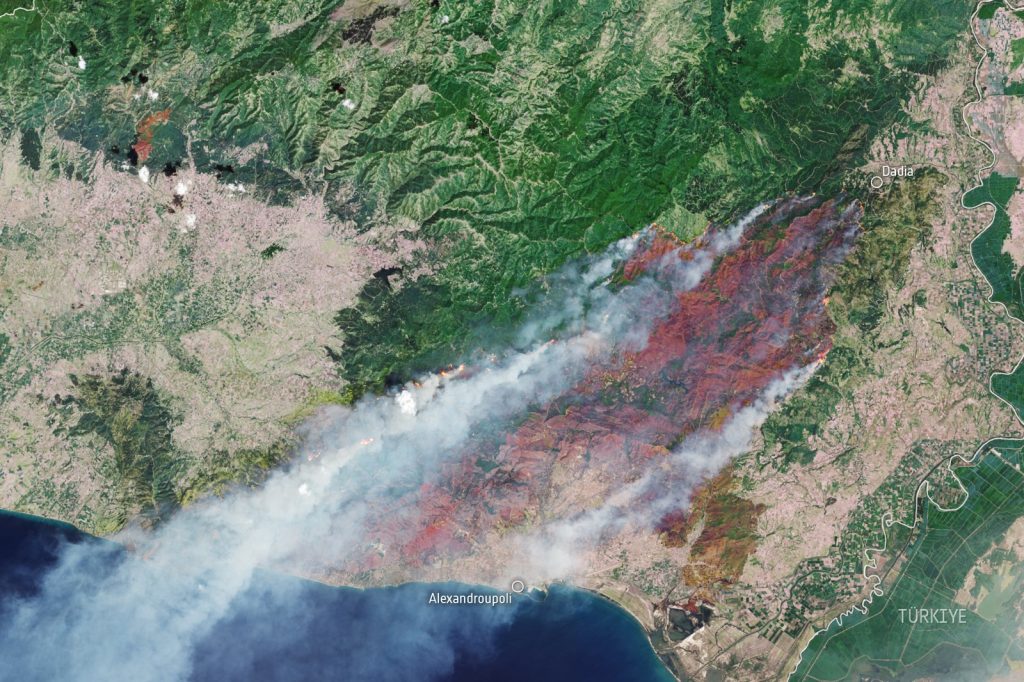
ROME, July 28 — Wildfire season in Europe has become a recurring drama that, each summer, tests the continent’s firefighting capacity and nerves. Against this backdrop, data from the European Forest Fire Information System (EFFIS) shows that 2023 ranked among the worst seasons on record: more than 1.2 million hectares of land burned across the European Union, the second-highest annual burned area since records began in 2000. Only the catastrophic 2017 season was more devastating.
The 2023 Season: A Continent Ablaze
Greece bore the brunt of the crisis with the largest single fire event ever recorded in the EU — the Alexandroupoli fire in August 2023, which consumed roughly 960 square kilometres and claimed at least 28 lives. Italy, Spain, Portugal, and France also suffered severe fires, stretching national resources to their limits. In the corridors of EU crisis management, the scale of the destruction raised urgent questions about preparedness and long-term strategy.
What is at stake extends beyond the immediate human toll. The economic damages from the 2023 wildfires are estimated in the billions of euros, with losses hitting agriculture, tourism, and property across several member states. For southern European nations, where summer tourism is a pillar of the economy, each fire season carries a direct financial blow that reverberates far beyond the scorched earth.
Climate Factors and Drought
The Copernicus Climate Change Service reported that summer 2023 was 2.6°C above pre-industrial averages, and that year globally was the hottest on record. Europe experienced its hottest summer on record as well. Against this backdrop, drought conditions across the Mediterranean — exacerbated by rising temperatures — have dried vegetation and extended what used to be a shorter fire season into a prolonged threat.
The wider picture is one of incremental change. While scientists point to climate change as a key driver, the EU’s response has focused on practical, operational measures rather than simply debating causality. The European Commission expanded the RescEU firefighting fleet in 2023, fielding 12 firefighting planes and 8 helicopters, and enhanced coordination through the European Union Civil Protection Mechanism. These moves reflect a shift toward shared resources and faster mutual aid among member states.
The EU’s Response and What Comes Next
The 2024 season has already brought significant fires, notably in Greece in June 2024. Early data suggests the high risk continues, and the pattern of increasingly intense summers is unlikely to break without deeper changes. In the corridors of EU environment and energy policy, the crisis has prompted calls for more ambitious climate mitigation and adaptation strategies — though the precise mix of measures remains a subject of debate among member states.
For Italy, fires in the summer of 2023 were a grim reminder of vulnerability. The country’s own firefighting fleet, often supplemented by EU assets, faced multiple fronts. What is at stake now is not just responding to each summer’s blazes, but reshaping land management, creating firebreaks, and investing in early detection systems.
The wider picture, as the 2026 season unfolds, is one of a continent learning to live with fire. The EU’s RescEU fleet and Civil Protection Mechanism are tangible steps forward, yet the billions in economic damages and the loss of life underscore that adaptation is still catching up with the pace of change.




