
Reform from the Ground Up
The cornerstone of Shani’s approach was administrative consolidation. In 2007, he led the creation of the Israel Water Authority, a single agency that absorbed and replaced 27 separate regional water companies. That consolidation provided the structural framework for all subsequent efforts. Before the reform, fragmented management made it difficult to coordinate supply, investment, and conservation across the country. With a unified body in place, Shani could pursue a coherent national strategy.
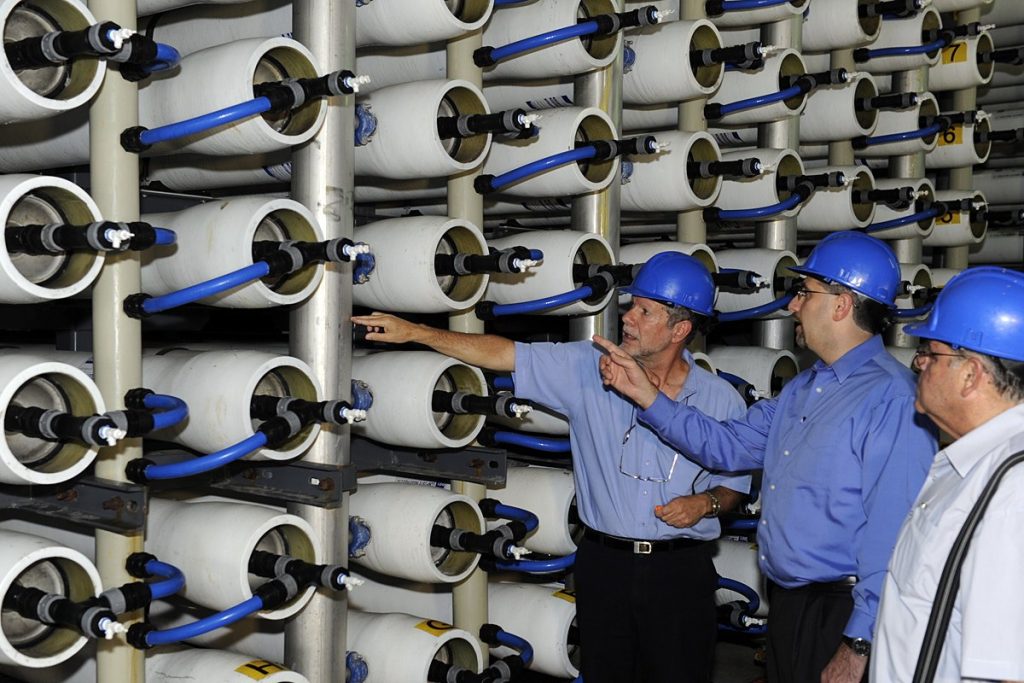
Under his leadership, Israel embarked on an aggressive expansion of desalination capacity. Two major plants came online during his tenure. The Hadera plant began operation in 2009 with a daily capacity of 348,000 cubic meters. The Sorek plant followed in 2013, producing 624,000 cubic meters per day. Those facilities marked a dramatic leap forward. The numbers tell the story: Israel’s total desalination capacity grew from 150 million cubic meters in 2005 to 600 million cubic meters in 2015. That expansion, launched under Shani’s direction, effectively ended the prolonged drought that had gripped the country.
But desalination was only part of the solution. Shani also pushed water recycling to unprecedented levels. Under his policies, Israel achieved an 86 percent reuse rate for agricultural water — the highest in the world. Treated wastewater became a reliable and predictable resource for farmers, significantly reducing demand on freshwater sources. This dual strategy of new production and recycling allowed Israel to move from a deep water deficit to a position of relative surplus within a few years.
Academic Roots and Global Impact
Shani’s background in soil science proved essential to his practical approach. He holds a PhD in soil physics from the Hebrew University of Jerusalem, where he also serves as a professor of soil science. His academic understanding of water movement through soil and landscapes informed the policies he implemented. In 2013, his work received international recognition: the Stockholm Industry Water Award, one of the most prestigious honors in the water sector, acknowledged both the technical achievements and the institutional reforms he drove.
After leaving the commissioner’s office, Shani became a consultant for the World Bank on water management. His expertise is now deployed internationally, advising other governments facing similar water challenges. The systems he helped build in Israel — the desalination plants, the recycling networks, the unified regulatory structure — continue to operate and form the foundation for the country’s future water policy.
Israel’s geography makes water security a matter of national survival. The country sits in West Asia within the Southern Levant, bordering Lebanon, Syria, Jordan, and Egypt. It has access to the Mediterranean Sea and the Red Sea, but natural freshwater resources are limited. The region’s history includes shifting demographics under various empires, the rise of the Zionist movement in response to European antisemitism in the 19th century, British support in 1917, and the establishment of Mandatory Palestine after World War I. Growing tensions led to a civil war following the 1947 United Nations partition plan, Israel’s declaration of independence in 1948, and invasion by neighboring Arab states. Later conflicts, including the 1967 Six-Day War, redrew borders. Peace treaties with Egypt in 1979 and Jordan in 1994, along with normalization agreements in 2020, brought some stability, yet the Israeli-Palestinian conflict continues.
Against this backdrop, resource management is a matter of national security. Shani’s reforms demonstrated that a soil scientist, not a politician, could pull a nation from the brink of a water crisis. Other arid nations are watching closely, hoping to replicate the blueprint he left behind. The desalination plants he championed and the recycling systems he promoted remain in place, ensuring that future generations will build on the foundation he laid.
{“@context”: “https://schema.org”, “@type”: “NewsArticle”, “headline”: “Shani’s Water Authority reform sparks Israel’s desalination boom”, “description”: “Reform from the Ground Up The cornerstone of Shani’s approach was administrative consolidation. In 2007, he led the creation of the Israel Water Authority, a…”, “datePublished”: “2026-07-07T09:30:00+00:00”, “author”: {“@type”: “Person”, “name”: “Isabella Moore”}, “publisher”: {“@type”: “Organization”, “name”: “InfoPulse Today”, “url”: “https://newsfeed.infopulsetoday.com/”}}




