
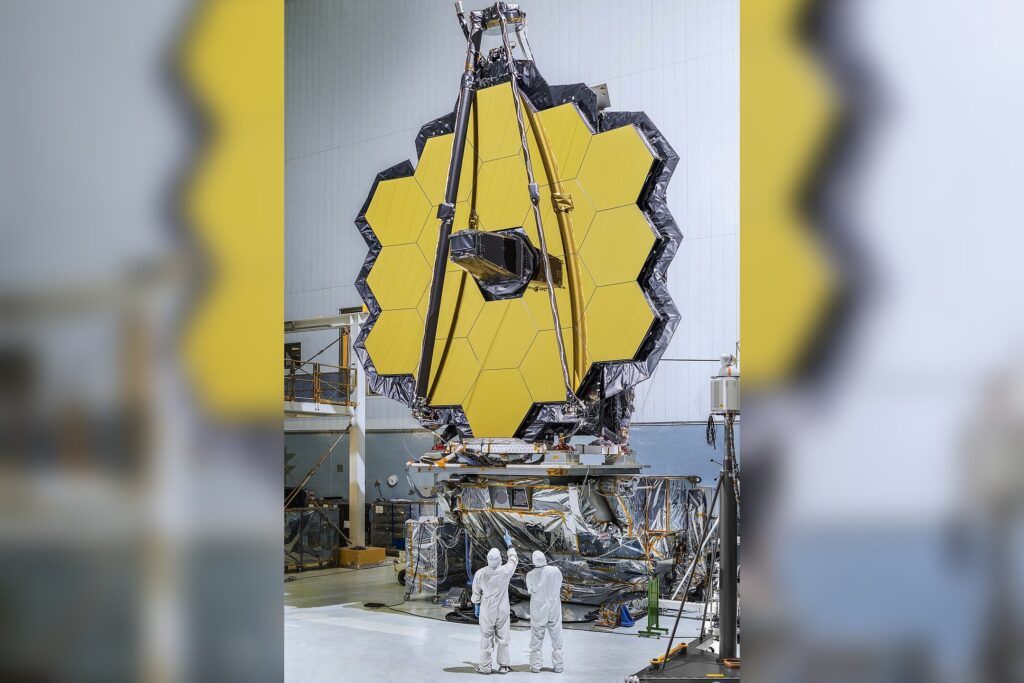
BALTIMORE, August 3 — The James Webb Space Telescope is set to transform far more than our understanding of the early universe. Its next act, unfolding now, is the search for life on distant exoplanets.
Astronomers are training Webb’s Near Infrared Spectrograph (NIRSpec) and Mid-Infrared Instrument (MIRI) on alien worlds as they cross in front of their parent stars. During these transits, starlight filters through the atmosphere and leaves behind a spectral fingerprint — a mix of chemicals that researchers can read from nearly 40 light-years away. Oxygen, methane, and water vapor are among the sought-after markers, each one a possible biosignature of life.
Early targets include the TRAPPIST-1 system, about 40 light-years from Earth, home to seven Earth-sized exoplanets. Three of those planets orbit within the habitable zone, the Goldilocks region where liquid water could exist on a rocky surface. It is an arrangement that has long fueled the imagination.
For communities across Asia, where night skies have inspired both myth and science for generations, the hunt carries a distinct resonance. A telescope built by many nations is now asking a question every culture has asked: are we alone?
Reading the chemical fingerprints of alien skies
The technique itself is elegant. When a planet passes in front of its host star, a tiny portion of starlight passes through the planet’s atmosphere before reaching Webb. That light is absorbed and re-emitted at specific wavelengths, depending on the molecules present. NIRSpec and MIRI are uniquely equipped to capture those signatures, turning a brief cosmic alignment into a detailed chemical profile.
This work goes beyond curiosity. Knowing whether Earth-sized worlds in habitable zones hold water vapor or methane will help scientists understand how common — or how rare — life’s building blocks really are. With three potentially habitable worlds in just one nearby system, the TRAPPIST-1 observations could reshape what we know about planetary habitability across the galaxy.
From stellar nurseries to icy time capsules
Webb is also looking at the birthplaces of stars and planets. The Orion Nebula, located 1,344 light-years from Earth, is a key target — a dense, dusty region where young stars are taking shape. Its infrared eyes can peer through the clouds that block visible light, revealing how planetary systems emerge from swirling cocoons of gas and dust.
The telescope is also reaching into the outer edges of our own solar system. By examining the chemical composition of comets, asteroids, and the icy bodies of the Kuiper Belt, scientists hope to understand the ingredients available when the solar system formed. That includes Pluto and Arrokoth, the latter visited by NASA’s New Horizons spacecraft in 2019. These frozen relics are time capsules, holding clues to how water and organic material may have reached early Earth — and, perhaps, other worlds.
More than 60 terabytes of discovery
Over the next decade, Webb’s observations are expected to produce a wealth of data. In its first year of operations alone, the telescope generated more than 60 terabytes of raw data. All of it is being processed and archived at the Space Telescope Science Institute here in Baltimore, Maryland, where the painstaking work of calibration and analysis turns raw pixels into scientific insight.
What comes next is the long, careful study of that data. The first confirmed detections of biosignatures may still be years away, but the telescope has already proven its power to look deeper and more precisely than anything before it. For astronomers in every corner of the world — and for everyone who has ever glanced up at a clear night sky — the wait is part of the wonder.
Sources
{“@context”: “https://schema.org”, “@type”: “NewsArticle”, “headline”: “JWST to Explore Exoplanets, Star Formation, Life’s Origins”, “description”: “BALTIMORE, August 3 — The James Webb Space Telescope is set to transform far more than our understanding of the early universe. Its next act,…”, “datePublished”: “2026-08-03T09:30:00+00:00”, “author”: {“@type”: “Person”, “name”: “Merry Gel Sigui”}, “publisher”: {“@type”: “Organization”, “name”: “InfoPulse Today”, “url”: “https://newsfeed.2bme.xyz/”}, “citation”: [{“@type”: “CreativeWork”, “url”: “https://en.wikipedia.org/wiki/Exoplanet”}]}




