
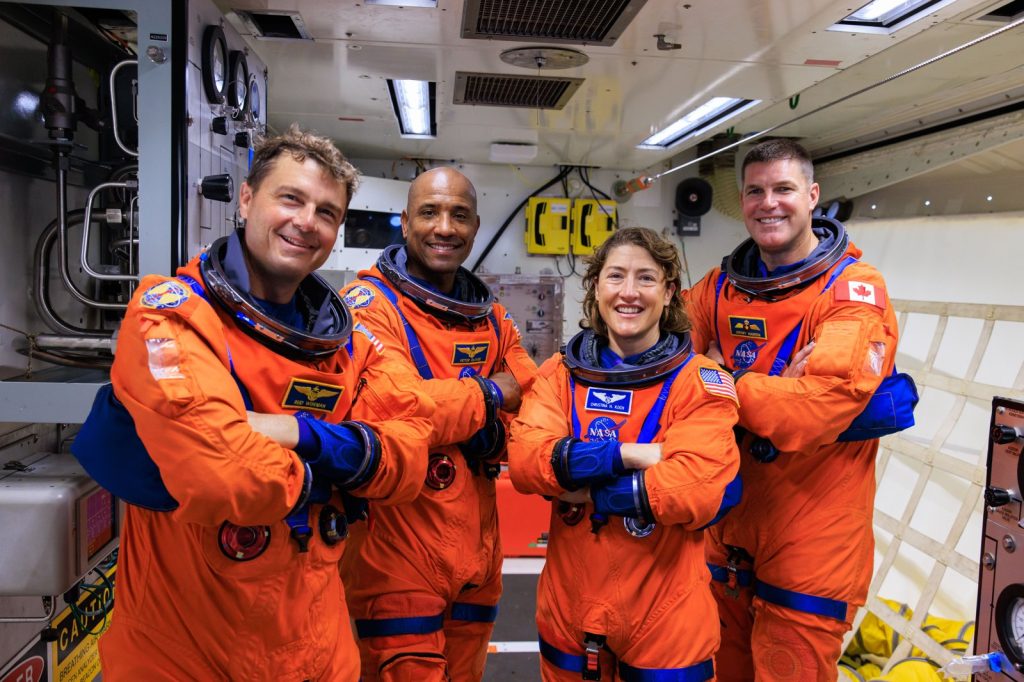
The four astronauts of NASA’s Artemis II mission have returned to Earth, and the agency is already applying lessons from their historic flight to prepare for a crewed lunar landing. During their 10-day journey around the Moon, the crew reached a maximum distance of 406,778 kilometers from Earth—surpassing the previous record held by Apollo 13 by approximately 6,607 kilometers. Unlike Apollo 13’s record, which was set under emergency conditions after a spacecraft failure, Artemis II achieved this distance on a planned trajectory with a fully functional vehicle.
NASA engineers are now analyzing data from the mission to refine plans for Artemis III, which aims to land astronauts near the lunar south pole. The Orion spacecraft’s performance during deep-space operations has provided critical information for future missions. Key systems tested included navigation, communications, and the heat shield—all of which operated successfully.
The heat shield’s performance is a primary focus of post-mission analysis. Orion endured the extreme temperatures of reentry after its voyage around the Moon. Had the shielding failed, the crew would not have survived. Engineers are examining telemetry and physical samples from the spacecraft’s exterior to verify its integrity, with findings expected to influence the design of future Orion capsules.
Navigation in deep space also proved reliable. While Apollo-era astronauts depended on star sightings and ground-based tracking, Orion utilized onboard sensors combined with NASA’s Deep Space Network. The spacecraft navigated without issues, demonstrating a capability essential for missions to more distant destinations such as asteroids or Mars.
Communications systems were tested over hundreds of thousands of kilometers, maintaining a constant link between the crew and Mission Control. This connection serves as a vital lifeline, and it functioned without interruption throughout the flight.
During the mission, NASA captured a total lunar eclipse from the far side of the Moon—a view never before recorded by a crewed spacecraft. The footage provides scientists with unique data on how sunlight interacts with the lunar surface during an eclipse, which could help inform future landing site selection.
The Artemis II mission marks the first time in 53 years that humans have traveled beyond low Earth orbit, a gap stretching from Apollo 17 in 1972 to the present flight. The crew is now back, and the capsule is undergoing inspection. Artemis III will use a modified version of the same Orion spacecraft. While the descent to the lunar surface presents new challenges—including precise engine burns, terrain recognition, and an untested landing system—the successful performance of Orion’s core systems reduces unknowns for the next mission.
NASA continues to build the path for returning humans to the Moon, one mission at a time. The next crew will attempt a landing, and subsequent missions may extend stays on the lunar surface.




