
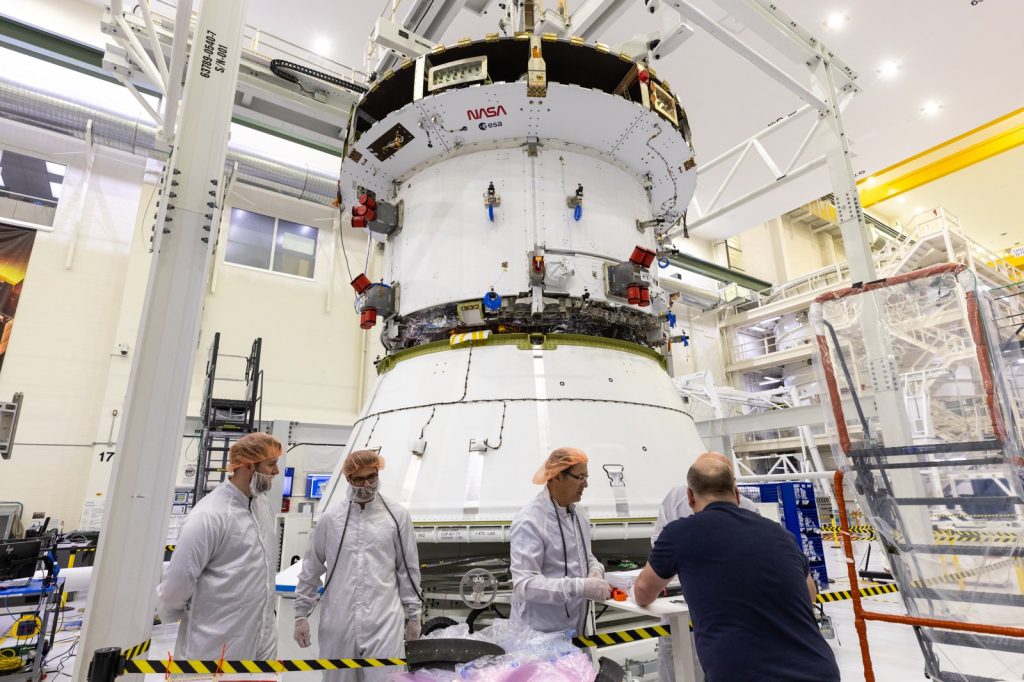
WASHINGTON, July 20 — A detailed mission architecture for Artemis III, based on engineering documents and NASA planning briefs, places the Orion crew capsule and SpaceX’s Starship Human Landing System at the center of what would be the first human return to the lunar surface since 1972. Orion, built by Lockheed Martin, consists of a Crew Module, the European Service Module supplied by Airbus Defence and Space, and a Launch Abort System.
The spacecraft can carry up to four astronauts on missions lasting up to 21 days without an additional habitat module. It has flown once — the uncrewed Artemis I test — and its first crewed flight is scheduled for Artemis II.
The Two-Spacecraft Plan
The Artemis III mission timeline calls for Orion to be launched atop the Space Launch System rocket, built by Boeing and Northrop Grumman. Once in lunar orbit, Orion will dock with the Starship HLS, which must first be refueled in low Earth orbit through an estimated 10 to 15 separate tanker launches. The HLS, a lunar-optimized variant of SpaceX’s Starship, stands about 50 meters tall and uses methane/LOX Raptor engines.
Two astronauts will transfer from Orion to the HLS for a surface stay of about one week. The HLS’s ascent stage will then lift the crew back to Orion, which serves as the deep-space lifeboat and primary crew transport.
Unlike the Apollo Lunar Module, which was integrated into the Command Module stack, Artemis uses separate commercial vehicles that must rendezvous and dock autonomously or with crew input.
Contract and Capabilities
NASA selected the Starship Human Landing System in April 2021 under a $2.9 billion contract. The HLS’s high payload capacity — able to deliver over 100 metric tons to the lunar surface in future configurations — allows for more extensive scientific equipment and eventually for building infrastructure. The descent and ascent stages of HLS are theoretically reusable, but the first mission is expected to discard elements.
On the timeline of development, Orion and SLS have faced years of delays and cost overruns, while Starship HLS is still awaiting its first successful orbital test flight. The rendezvous and docking sequence, which will be executed autonomously or with crew input, represents a new operational mode for crewed lunar missions.
The record shows that, unlike Apollo’s single-vehicle architecture, Artemis III depends on the coordinated performance of two commercially procured spacecraft that were designed and built separately.
What Comes Next
Artemis II, which will carry crew around the Moon but not land, remains the next milestone. After that, the full Artemis III stack — Orion, SLS, and the Starship HLS — will need to demonstrate that the refueling chain, the autonomous docking, and the landing sequence all work as designed. Sources familiar with the program say NASA has not yet set a target date for Artemis III, pending the outcomes of the earlier missions.




