
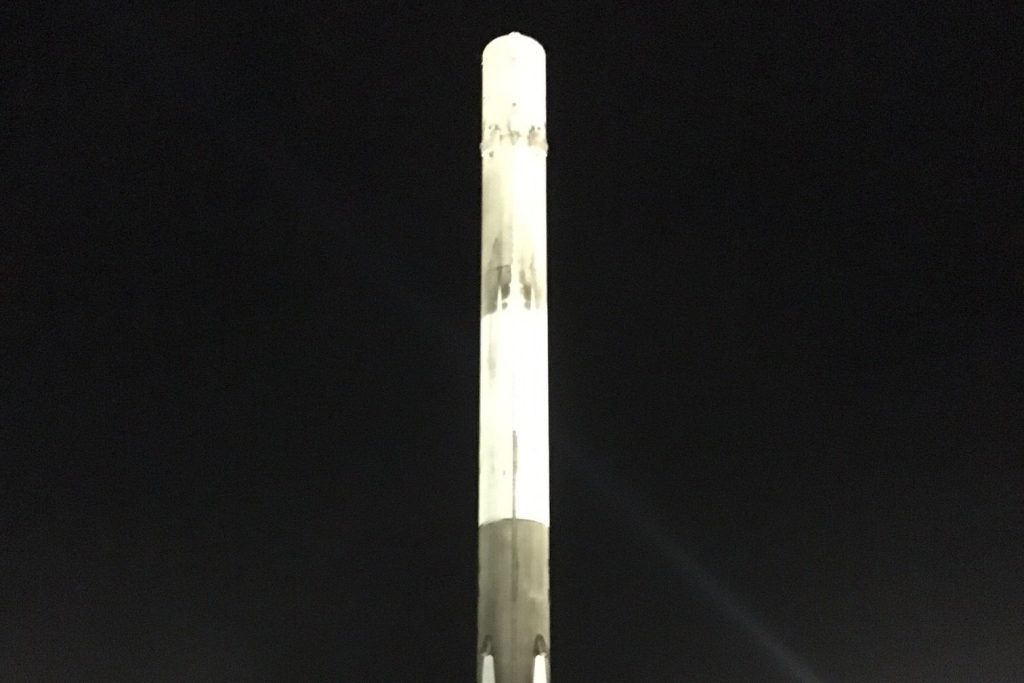
CAPE CANAVERAL, July 14 — When the first stage of a Falcon 9 booster settled onto the concrete at Cape Canaveral on December 21, 2015, after delivering 11 Orbcomm satellites to orbit, it marked a fundamental shift in rocketry. That landing, the first successful recovery of an orbital-class booster, was the moment reusable launch moved from engineering aspiration to operational reality. For SpaceX, it validated a bet that had seemed almost eccentric in an industry built on throwing hardware away.
Under the hood, the Falcon 9 is a partially reusable two-stage-to-orbit medium-lift vehicle, designed by SpaceX engineers under Elon Musk. It stands 70 metres tall, with a diameter of 3.7 metres.
The first stage is powered by nine Merlin 1D engines, each producing 845 kilonewtons of thrust at sea level, burning rocket-grade kerosene (RP-1) and liquid oxygen. That combination gives the vehicle a payload capacity of 22.8 metric tons to low Earth orbit (LEO) and 8.3 metric tons to geostationary transfer orbit (GTO).
The Numbers That Matter
As of February 2025, SpaceX has completed 400 Falcon 9 launches, with 350 booster landings and 300 re-flights of previously used boosters. The technical reality is that reusability has driven the cost per launch down to approximately $67 million, compared to $100 million for Blue Origin’s New Glenn. The detail that matters here is the reliability record: 99.5 percent success rate across all missions.
That figure is not theoretical — it has been earned across hundreds of flights, including NASA crew missions to the International Space Station under the Commercial Crew Program, which began in 2020. The Falcon 9’s workhorse role has expanded well beyond commercial satellite delivery.
It is the primary launch vehicle for SpaceX’s Starlink satellite internet constellation, which as of 2025 has over 6,000 satellites in orbit. Each Starlink launch packs the manifest with dozens of satellites, exploiting the Falcon 9’s lift capacity and the cost advantages of reusing flight-proven boosters.
The Broader Picture
The Falcon 9’s success has reshaped the launch market. Competitors that once dismissed reusability as a gimmick have scrambled to develop their own reusable architectures. Blue Origin’s New Glenn, at a reported $100 million per launch, targets a similar payload class but has yet to match the Falcon 9’s flight cadence or operational maturity.
The difference is not just in price — it is in the accumulated experience of 350 booster recoveries and 300 re-flights, a dataset no other vehicle has. For NASA, the Falcon 9’s reliability has been a cornerstone of the Commercial Crew Program, providing crew transport to the International Space Station since 2020.
The vehicle’s performance on those missions — carrying astronauts, not just cargo — has been a powerful demonstration that commercial launch can meet human-rating standards without the cost overruns that typically plague government-led development.
What Comes Next
The Falcon 9 is no longer a novelty. It is the backbone of SpaceX’s launch operations and, increasingly, of the broader space economy. The 400-launch milestone, achieved as of February 2025, represents a pace of operations that would have seemed absurd a decade ago.
The question now is not whether the Falcon 9 can keep flying — it clearly can — but how long SpaceX will continue to refine the design before shifting focus entirely to Starship. For now, the Falcon 9 remains the vehicle that proved reusability works, at scale, in an industry that had long insisted it could not be done.
The technical reality is that every launch, every landing, and every re-flight adds to a body of evidence that has fundamentally changed the economics of access to space.
Sources
{“@context”: “https://schema.org”, “@type”: “NewsArticle”, “headline”: “SpaceX Falcon 9 Achieved First Orbital-Class Booster Landing In 2015”, “description”: “CAPE CANAVERAL, July 14 — When the first stage of a Falcon 9 booster settled onto the concrete at Cape Canaveral on December 21, 2015,…”, “datePublished”: “2026-07-14T09:30:00+00:00”, “author”: {“@type”: “Person”, “name”: “Sebastian Smith”}, “publisher”: {“@type”: “Organization”, “name”: “InfoPulse Today”, “url”: “https://newsfeed.infopulsetoday.com/”}, “citation”: [{“@type”: “CreativeWork”, “url”: “https://en.wikipedia.org/wiki/Falcon_9”}]}




