
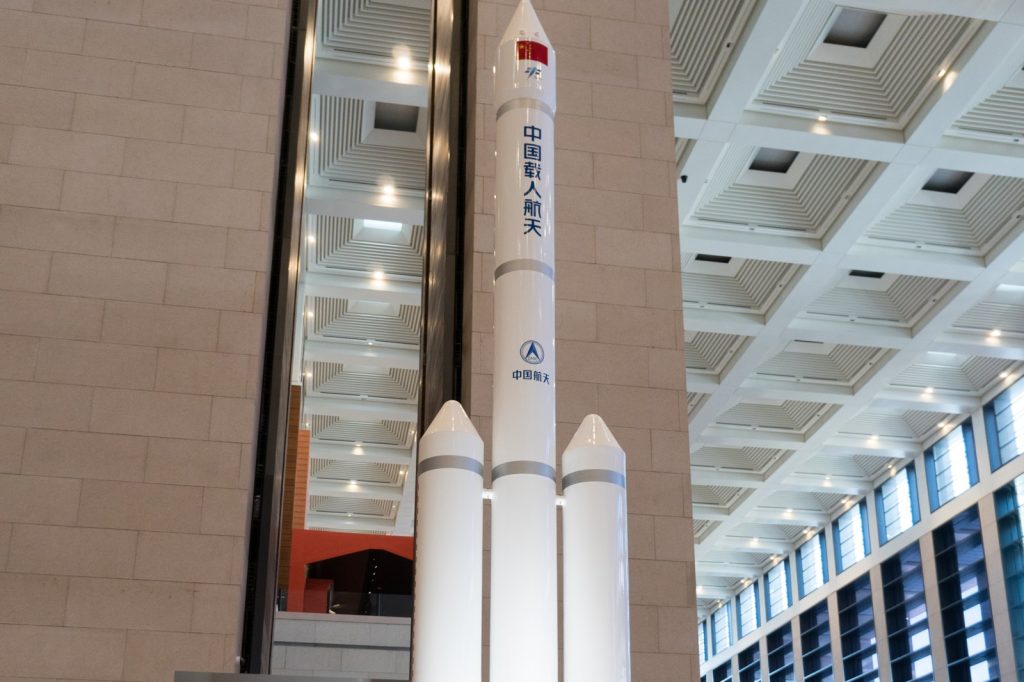
WENCHANG, July 10 — The Long March 10B, China’s newest heavy-lift rocket, is now being prepared for commercial missions after its successful maiden flight just over a year ago. Developed by the China Aerospace Science and Technology Corporation (CASC), this vehicle is the first in the Long March family designed from the ground up for reusability, a shift that promises to reshape the economics of space access for countries across Asia. The rocket stands 90 meters tall, with a diameter of 5 meters.
At liftoff, it generates 2,600 metric tons of thrust from its first stage, which uses seven YF-100K engines. The second stage is powered by two YF-100M engines.
With a liftoff mass of approximately 2,200 metric tons, the Long March 10B can deliver up to 27 metric tons to low Earth orbit (LEO) or 14 metric tons to geostationary transfer orbit (GTO). These payload capacities place it in the same class as the most powerful rockets currently in service globally. The maiden flight took place on June 23, 2024, when the Long March 10B carried the Shiyan-24 satellite into orbit.
That satellite, weighing 3.5 metric tons, was placed into a 200-kilometer orbit. More significant than the payload, however, was what happened after stage separation.
The first stage, which has a dry mass of about 25 metric tons, returned to Earth and landed at a recovery site located 200 kilometers downrange from the Wenchang launch site. According to CASC, the landing accuracy was within 10 meters of the target, a level of precision that underscores the maturity of the guidance and control systems.
Cost savings for the region
The economic implications of reusability are substantial. CASC estimates that reusing the first stage will reduce launch costs by 30 percent compared to expendable versions of the rocket. The current estimated cost per kilogram is $15,000 for an expendable launch, which would drop to $10,500 per kilogram with a recovered and refurbished first stage.
For universities, research institutions, and commercial satellite operators in countries like the Philippines, Indonesia, Vietnam, and Thailand — where budgets for space programs are often modest — that reduction could mean the difference between a project moving forward or remaining on the drawing board. The development cost of the Long March 10 series has been reported at 20 billion yuan, or approximately $2.8 billion, as of 2023.
That figure covers the research, design, testing, and initial production of the rocket family, which includes multiple variants. For comparison, developing a new heavy-lift rocket from scratch in other spacefaring nations often runs into the billions of dollars as well, but the Chinese program has benefited from a centralized development structure and a clear mission roadmap.
What reusability means for communities
For communities across the region, lower launch costs open up possibilities that were previously out of reach. A Philippine agricultural monitoring consortium, for example, could afford to launch a dedicated satellite to track crop health and typhoon damage in real time. A Malaysian maritime surveillance project could put up a constellation of small satellites to monitor illegal fishing in the Sulu and South China seas.
These are not hypothetical scenarios — several Southeast Asian nations have already begun developing their own satellite capabilities, but the high cost of launch has been a persistent barrier. The Long March 10B’s reusability is not just a technical achievement.
It represents a structural change in how space access is priced. When a rocket’s first stage can be flown, recovered, inspected, refueled, and flown again, the per-mission cost drops dramatically. The first stage is the most expensive part of any rocket, containing the majority of the engines, fuel tanks, and avionics.
Being able to reuse that component multiple times spreads its cost across many missions. The rocket’s landing accuracy of within 10 meters of the target is also noteworthy for operational planning.
A precise landing means the recovery team can reach the stage quickly, reducing turnaround time between launches. For customers waiting to get their payloads into orbit, a shorter launch cadence is a direct benefit.
Looking ahead
The Long March 10B is now entering what CASC describes as a phase of regular commercial operations. The rocket’s ability to deliver 27 metric tons to LEO makes it suitable for large satellite constellations, space station resupply, and future crewed missions. The 14-metric-ton capacity to GTO positions it well for communications satellites that serve the Asia-Pacific region.
Closer to home, the development of the Long March 10 series has been a point of pride for China’s aerospace community, but its real value will be measured in the missions it enables for partners across the region. As more countries in Asia look to space for solutions to terrestrial problems — from disaster monitoring to internet connectivity — the availability of affordable, reliable launch services becomes a matter of practical development policy.
The Long March 10B has demonstrated that reusability works at this scale. The next question is how quickly CASC can ramp up the flight rate and bring costs down further. For the many communities across Asia waiting for their turn in orbit, that pace matters.




