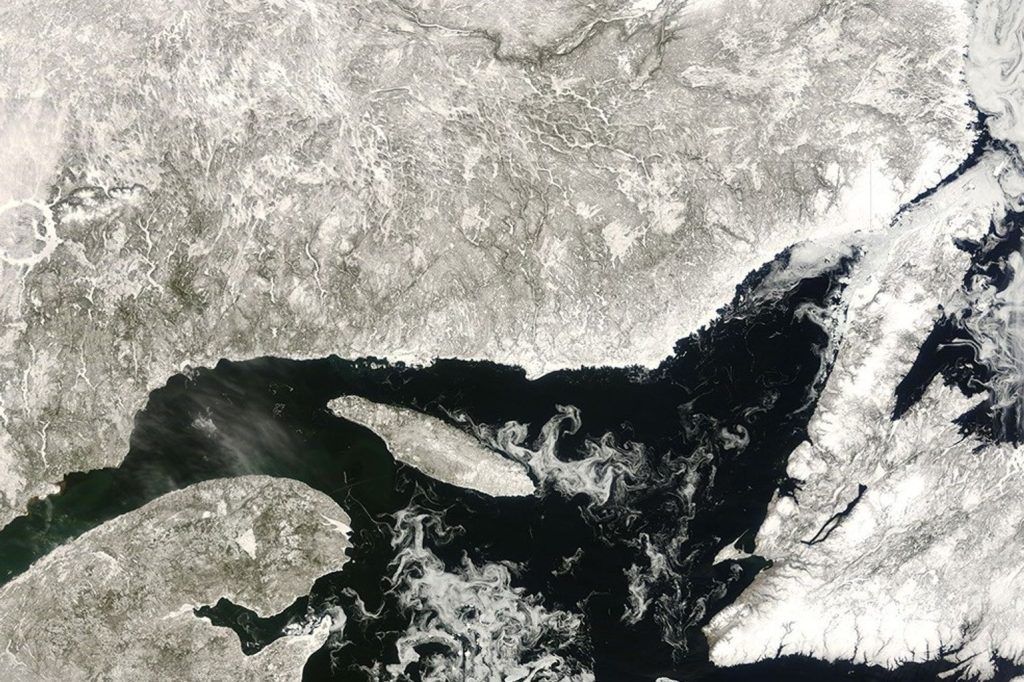
Last summer, as Julien Vadnais and his team tested satellite-tracking software in the Gulf of St. Lawrence, they stumbled onto something they never expected: a 30,000-litre oil leak from the seabed. It was not a spill from a tanker or a pipeline rupture. It was natural.
The first ever documented in those waters. Vadnais, a PhD student at the University of Bergen in Norway, told Le Devoir the discovery was pure accident.
“In August 2025, we tested our algorithms in the Gulf of St. Lawrence out of curiosity, to see what the coverage and quality of the satellite data were like. That was when a major natural oil leak was occurring. We weren’t expecting it at all.” That leak lasted roughly 50 days.
The oil flowed from an area northwest of Old Harry — a geological formation that once drew serious interest from fossil-fuel companies. Old Harry sits about 35 kilometres from the seep site.
The connection is not casual. The researchers argue, based on seismic data and the region’s geology, that the oil likely escaped from a shallow accumulation after migrating from a pre-existing deposit, possibly over several kilometres. The volume — more than 30,000 litres — was not guessed at.
It was measured using a buoy collecting oceanographic data in the area. That kind of quantification matters. It tells scientists something about the subsurface.
It raises questions about what else might be down there. But Vadnais was categorical on one point.
The researchers have not discovered an exploitable oil deposit. There is no commercial prize here. Nor, according to the scientists, did the leak pose any environmental risk.
The oil came up. It spread.
It did not trigger a crisis. The study was published in the scientific journal Geology. Vadnais and his colleagues are developing “algorithms based on radar satellite data to detect natural hydrocarbon leaks at sea.” The Gulf test was supposed to be a dry run.
Instead, it became a live demonstration. This changes how geologists think about the region. The St. Lawrence Gulf has long been understood as a sedimentary basin.
Oil companies have poked around it. Old Harry itself was a target.
But a confirmed natural seep changes the picture. It means oil is moving through the rock right now. It means the geology is active in ways not fully mapped.
The leak was detected in Québec waters. That puts it under Canadian jurisdiction.
It raises questions about monitoring. If natural seeps happen, and satellite data can catch them, what else is the satellite seeing? What else has been missed?
Vadnais and his team were not looking for oil. They were testing software. The leak found them.
That is how science sometimes works. You aim at one thing and hit another.
The Gulf of St. Lawrence now has a documented natural oil seep. First of its kind. Likely not the last.
The study does not settle the larger debate about drilling in the region. It does not endorse it.
It does not forbid it. It simply reports what happened. Oil leaked from the seabed.
Scientists measured it. They published their findings. The geology, they say, is more complicated than previously understood.
For now, the leak is over. The oil is gone.
The data remains. And a PhD student in Norway has a story to tell about the summer he tested an algorithm and found a 30,000-litre oil leak instead.