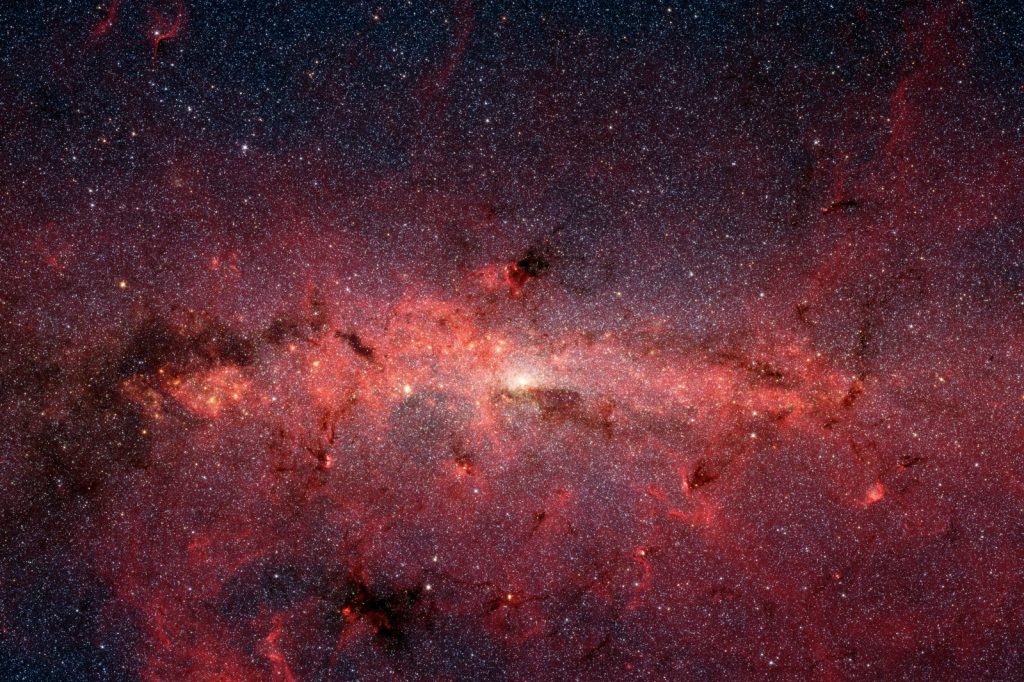
GREEN BANK, W.Va., July 13 — A giant molecular cloud near the center of our galaxy has been quietly holding a secret that could reshape how scientists understand the origins of life. Astronomers have known for years that Sagittarius B2 is a chemical factory in space. But the discovery there of a simple sugar called glycolaldehyde in 2012 marked the first time researchers found evidence of a sugar in interstellar space, and that finding still reverberates through the field today.
The cloud itself is enormous. Sagittarius B2 spans about 150 light-years across, making it one of the largest star-forming regions in the Milky Way.
It sits roughly 26,000 light-years from Earth, close to the galactic center. Think of it like a deep-freeze warehouse packed with the raw ingredients for stars and planets — alcohols, acids, and now sugars — all locked in a dense, cold environment that mimics the conditions of our own early solar system. Here’s what makes that significant, in plain terms.
If simple sugars can form in a cloud like Sagittarius B2, they could have been present in the material that eventually coalesced into our solar system billions of years ago. The practical upshot is that some of the basic building blocks for life might not have originated on Earth at all.
They could have arrived here, hitchhiking on comets or asteroids, already assembled in space. The cloud’s chemistry is unusually rich. It contains a wide variety of complex organic molecules, and the detection of glycolaldehyde was a breakthrough because sugars are fundamental to life as we know it.
They form the backbone of RNA, which many scientists believe was a precursor to DNA. So finding a sugar in a place like Sagittarius B2 offers a concrete example of how these molecules can arise naturally, without any biological processes. Astronomers study Sagittarius B2 so intently because its dense, frigid conditions are a stand-in for the early solar system.
The cloud is essentially a time capsule. By analyzing its chemical inventory, researchers can piece together what kinds of molecules were available before planets even existed.
It’s like finding the recipe book for life, written in the language of interstellar chemistry. The practical upshot for ordinary readers is this: the line between space and life on Earth is blurrier than we once thought. The same molecules that make up our bodies and our food are out there, floating in a cloud 26,000 light-years away.
That doesn’t prove life exists elsewhere, but it does suggest the chemical prerequisites are far more common than scientists assumed a generation ago. What to watch next: astronomers are now scanning Sagittarius B2 for even more complex sugars and other prebiotic molecules.
Each new detection adds another piece to the puzzle of how life’s ingredients assembled before Earth even formed. The cloud is far from done giving up its secrets.