
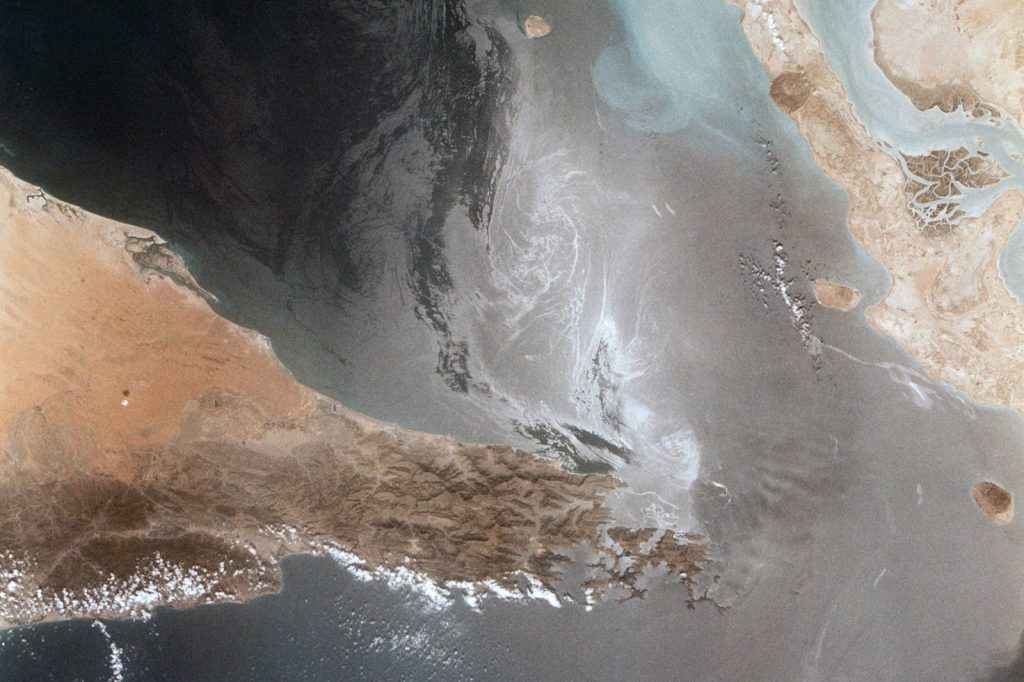
TEHRAN, July 12 — For decades, the 21-mile-wide waterway known as the Strait of Hormuz has quietly underpinned the daily rhythm of modern life for billions of people. It is a narrow ribbon of sea connecting the Persian Gulf to the Gulf of Oman, and it is the world’s most important oil transit chokepoint. According to the U.S. Energy Information Administration, as of 2023, the strait handles about 20 million barrels of crude oil and petroleum products every single day.
That volume represents roughly 21% of global petroleum consumption. To grasp what that means for global energy security, consider the geography.
The shipping lanes through the strait are only 2 miles wide in each direction. That is a remarkably tight squeeze for the enormous tankers that carry the lifeblood of industrial economies. Any disruption here — a stray mine, a military confrontation, a political standoff — can send shockwaves through energy markets within hours.
The major oil producers that rely on this passage include some of the biggest names in the industry: Saudi Arabia, Iraq, Kuwait, the United Arab Emirates, and Iran itself. But it is not just crude oil that flows through these waters.
The strait is also a key route for liquefied natural gas, or LNG. Qatar, the world’s largest LNG exporter, ships most of its supply through this narrow corridor. For families in Asia and Europe who depend on natural gas for heating and electricity, the health of this waterway is a quiet but constant factor in their monthly bills.
A history of flashpoints
The Strait of Hormuz has been a flashpoint for conflict long before the current era. During the Iran-Iraq War, which lasted from 1980 to 1988, both sides attacked oil tankers in what became known as the Tanker War. That period saw the U.S. Navy reflag Kuwaiti tankers to protect them from Iranian attacks, a direct military commitment to keeping the strait open.
More recently, in 2019, attacks on Saudi oil facilities underscored just how vulnerable this critical infrastructure remains. The U.S. Energy Information Administration has identified the strait as a critical vulnerability in global energy security.
That designation is not abstract. When tensions rise in the region, insurance rates for tankers spike, shipping companies reroute vessels, and the cost of moving oil around the world increases. Those costs eventually show up at the pump, affecting families who never think about the geography of the Persian Gulf.
The human side of a chokepoint
Behind the statistics and the geopolitical analysis are real people whose livelihoods depend on the safe passage of these vessels. The crews of the tankers, the port workers in Fujairah and Ras Tanura, the engineers who maintain the loading terminals — all of them work in an environment where a single miscalculation can have catastrophic consequences. The shipping lanes are only 2 miles wide in each direction, which means there is very little room for error when a fully laden supertanker navigates these waters.
For the nations that border the strait, the waterway is both a source of enormous wealth and a persistent security concern. Iran, which sits on the northern shore, has historically threatened to close the strait in response to economic sanctions or military pressure.
Such a move would be a dramatic escalation, one that would cut off roughly 21% of the world’s daily petroleum consumption. The economic fallout would be immediate and severe, affecting everything from transportation costs to the price of plastics and pharmaceuticals. What this means for patients, for families, for anyone who relies on the global economy is straightforward: the Strait of Hormuz is not just a line on a map.
It is a critical artery that, if blocked, would disrupt the supply of energy that powers hospitals, schools, and homes. The U.S. Energy Information Administration’s assessment of the strait as a critical vulnerability is a reminder that the systems we depend on are often more fragile than they appear.
What to watch next
As of mid-2026, the strategic importance of the Strait of Hormuz shows no sign of diminishing. The global transition toward renewable energy sources is underway, but it is a slow process. For the foreseeable future, the world will continue to depend on the oil and LNG that flows through these 21 miles of water.
The question that hangs over the region is whether the nations that share this waterway can manage their differences without disrupting the flow of energy that the rest of the world depends on. The history of the strait suggests that periods of calm are often followed by periods of crisis.
The Tanker War of the 1980s and the 2019 attacks on Saudi facilities are reminders that this waterway has been, and likely will remain, a central arena for geopolitical competition. For now, the ships keep moving, the oil keeps flowing, and the families who depend on that energy go about their lives unaware of the narrow, vulnerable passage that makes it all possible.




