
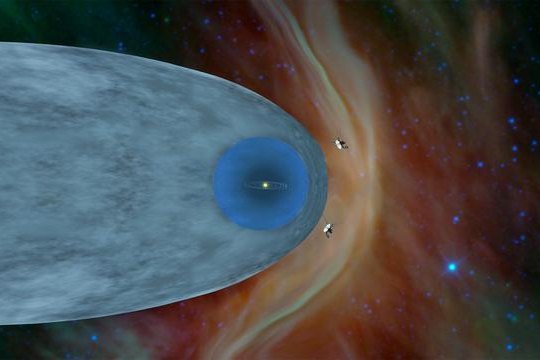
NEW YORK, July 9 — The edge of our solar system is not a clean, hard wall. It’s a roiling, dynamic frontier where the Sun’s influence finally gives way to the vastness of interstellar space. Scientists call this boundary the heliopause, and thanks to a pair of aging but still-operative NASA probes, we are getting our best look yet at what happens when our star’s breath meets the galactic wind.
Think of it like a cosmic tug-of-war. The Sun constantly blows a bubble of charged particles—the solar wind—outward in all directions.
This bubble, the heliosphere, is enormous, extending far beyond the orbit of Pluto. The heliopause is the precise point where that solar wind finally runs out of steam, meeting the matter and radiation that fills the space between stars, known as the interstellar medium. It is not a static shell.
The heliopause is a dynamic region, its shape and location shifting over time as the Sun’s activity waxes and wanes. Here’s what we know about its location.
The heliopause is estimated to lie somewhere between 100 and 120 AU from the Sun. We have two confirmed data points. Voyager 1 crossed the heliopause at about 121 AU.
Its twin, Voyager 2, crossed at about 119 AU. Data from the Voyagers revealed something surprising. The heliopause is not a simple barrier.
It is a complex region with magnetic fields and plasma interactions. But the Voyagers are old.
Their instrument suites could only tell part of the story. That is where New Horizons comes in. The probe that gave us our first close-up look at Pluto is now hurtling toward the heliopause, and it carries instruments that the Voyagers did not.
It is equipped to measure dust density and plasma waves in this frontier region—two key pieces of data that were not fully characterized by its predecessors. The dust measurement is particularly intriguing.
The interstellar medium contains microscopic grains of material. New Horizons will be able to map the density of this dust as it approaches and crosses the heliopause. Plasma waves are another missing piece.
The Voyagers detected some wave activity, but their instruments were not optimized for the full spectrum of oscillations that occur in this region. New Horizons will listen for these waves. The data from New Horizons will also help resolve a long-standing puzzle.
The Voyagers suggested that the heliopause is not a smooth surface but a region of magnetic reconnection and turbulence. But with only two data points, it is hard to tell how typical those observations are.
New Horizons will provide a third, independent measurement at a different time and a different location. The probe is still years away from crossing the heliopause itself. But it is already sending back data from the outer reaches of the heliosphere, providing a preview of what awaits.
What to watch next: As New Horizons continues its journey, scientists will compare its data with the aging Voyager readings to build a more complete model of the heliopause.




