
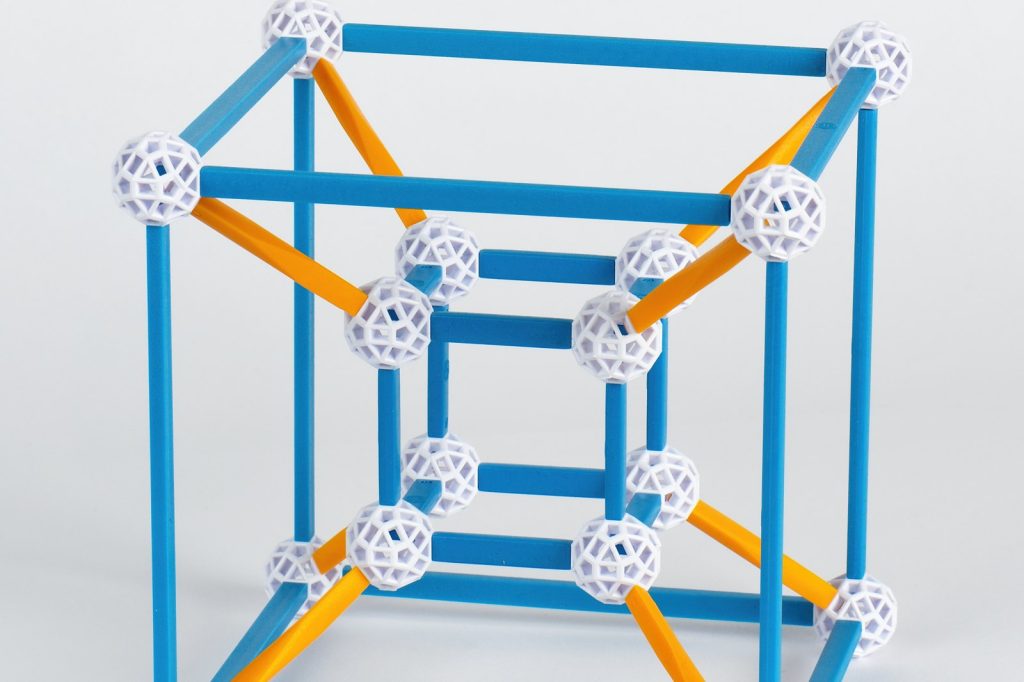
Construction from First Principles
The construction of a hypercube follows a clear, stepwise timeline that begins with the simplest geometric entity. A point is defined as a hypercube of dimension zero. Moving that point one unit length sweeps out a line segment, which is a unit hypercube of dimension one. Moving that line segment its own length in a perpendicular direction generates a two-dimensional square. In turn, moving the square one unit length perpendicular to its plane produces a three-dimensional cube. The final step in the four-dimensional case involves moving the cube one unit length into the fourth dimension, yielding a four-dimensional unit hypercube, or unit tesseract. This process can be generalized to any number of dimensions, establishing a pattern that mathematicians have explored since the 1800s.
Scholars such as the Dutch mathematician Pieter Schoute and the British geometer Alicia Boole Stott were among those who systematically studied four-dimensional figures in the early 1900s. The formal terminology reflects this history: an n-dimensional hypercube is more commonly referred to as an n-cube, or sometimes as an n-dimensional cube. The term “measure polytope,” originating from Elte in 1912, is also used, notably in the work of H. S. M. Coxeter, who labels hypercubes the γn polytopes.
Coordinates and Geometric Structure
The precise mathematical definition of a unit hypercube of dimension n is the convex hull of all 2ⁿ points whose n Cartesian coordinates are each equal to either 0 or 1. Those points constitute its vertices. The hypercube with these coordinates is also the Cartesian product [0,1]ⁿ of n copies of the unit interval [0,1]. The longest diagonal of a unit hypercube in n dimensions is equal to √n. The hypercube is the special case of a hyperrectangle, also called an n-orthotope. The d-dimensional hypercube is the Minkowski sum of d mutually perpendicular unit-length line segments, and is therefore an example of a zonotope. The 1-skeleton of a hypercube is a hypercube graph.
The record shows that a hypercube is a closed, compact, convex figure whose 1-skeleton consists of groups of opposite parallel line segments aligned in each of the space’s dimensions, perpendicular to each other and of the same length. This structural clarity allows mathematicians to define the shape from zero dimensions upward, making the hypercube a matter of record.
Relevance Beyond Pure Mathematics
Hypercubes are not merely abstract puzzles confined to geometric literature. They appear in computer science, data analysis, and coding theory. The structure of a hypercube graph, for example, underlies the design of certain computer networks and parallel processing systems. Understanding how a tesseract is built helps people grasp how geometry scales into higher dimensions, a skill increasingly relevant in fields from machine learning to physics. For readers, the tesseract offers a concrete way to think about spaces that cannot be directly seen but can be logically described and used. The full implications of these structures for higher-dimensional geometry continue to be explored, but for now, the definitions stand — from zero dimensions upward, the hypercube is a matter of record.




