
BOSTON, July 13 — The man who helped bring battery storage to millions of homes through Tesla’s Powerwall is now betting on a radically different chemistry to reshape how entire regions keep the lights on. Mateo Jaramillo, CEO and co-founder of Form Energy, built his career at the intersection of engineering and energy policy. Before launching Form Energy in 2017, he served as Director of Energy Storage at Tesla, where he led development of the Powerwall and Powerpack products.
His earlier work included stints at A123 Systems and at the U.S. Department of Energy’s Advanced Research Projects Agency-Energy, known as ARPA-E. Jaramillo holds a B.S. in Mechanical Engineering from the University of Notre Dame and an M.B.A. from the MIT Sloan School of Management.
That mix of technical grounding and business acumen has shaped his approach to a problem that has long vexed the renewable energy industry: what happens when the sun doesn’t shine and the wind doesn’t blow, not just for hours, but for days.
Iron, air, and a different kind of battery
Form Energy’s answer is the iron-air battery. Unlike the lithium-ion cells that power phones, cars, and home backup systems, these batteries use iron and oxygen to store energy. They are heavier and less energy-dense than lithium-ion, but they are also far cheaper and can discharge electricity for much longer periods — up to 100 hours, according to the company.
For communities across Asia, where grid reliability remains a daily concern in many places, long-duration storage could change the calculus for how countries invest in renewable power. Instead of building natural gas plants to cover multi-day lulls in solar or wind output, utilities could stack iron-air batteries in large arrays and draw on them over several cloudy or windless days.
The company has raised more than $1.2 billion in funding since its founding. A significant portion came in 2023, when the U.S. Department of Energy’s Loan Programs Office committed a $760 million investment to Form Energy. That backing signals the federal government’s interest in technologies that can backstop a grid increasingly reliant on variable generation.
A factory in West Virginia, a target for 2025
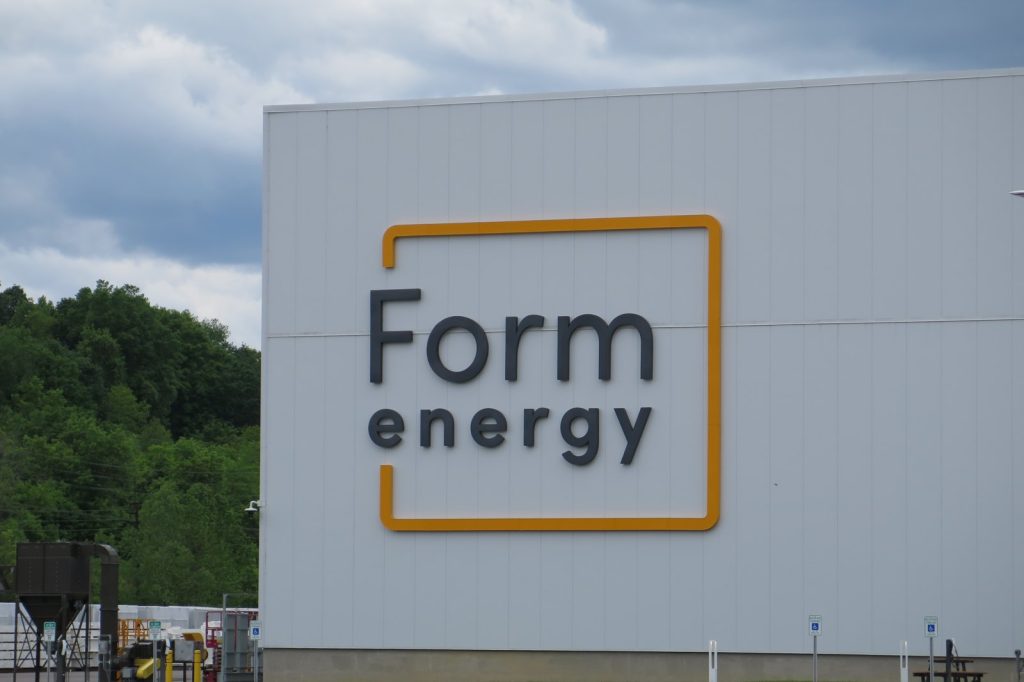
Form Energy’s first manufacturing facility is taking shape in Weirton, West Virginia. The plant is expected to produce 2 GW of iron-air batteries annually. For context, a gigawatt of storage capacity can power roughly 750,000 homes for the duration of a typical discharge cycle, though actual numbers depend on local grid conditions and demand patterns.
Commercial deployment is targeted for 2025. That timeline puts Form Energy on the cusp of moving from pilot projects to real-world utility contracts.
For families in Asia, where electricity costs can swing wildly with fuel prices, the prospect of cheap, long-duration storage could mean more stable power bills and less reliance on imported coal or liquefied natural gas. Closer to home, the approach has drawn attention from grid operators and energy ministries across the region. Several Southeast Asian countries have set ambitious renewable energy targets but have struggled with the intermittency problem.
Iron-air batteries, if they scale as Jaramillo envisions, could offer a path forward that does not require expensive pumped-hydro dams or unproven hydrogen storage.
A career shaped by energy storage’s evolution
Jaramillo’s trajectory tracks the maturation of the energy storage industry itself. At A123 Systems, he worked on advanced lithium-ion chemistries for automotive and grid applications. At ARPA-E, he saw early-stage technologies that were too risky for private capital but held promise for transforming energy systems.
At Tesla, he helped commercialize storage for mass markets. Now, with Form Energy, he is pushing the frontier in a different direction.
Instead of chasing higher energy density and faster discharge, the company is optimizing for low cost and long duration. That tradeoff makes sense for grid operators who need to balance supply and demand over days, not minutes. For communities across Asia, where power outages can disrupt hospitals, factories, and schools, the arrival of affordable long-duration storage could be transformative.
The technology will not solve every grid problem, but it addresses one of the most stubborn: how to keep electricity flowing when renewable generation dips for extended periods. The next few years will tell whether iron-air batteries can deliver on their promise.
Jaramillo and his team are betting that the answer is yes, and that the factory in Weirton is just the beginning.




