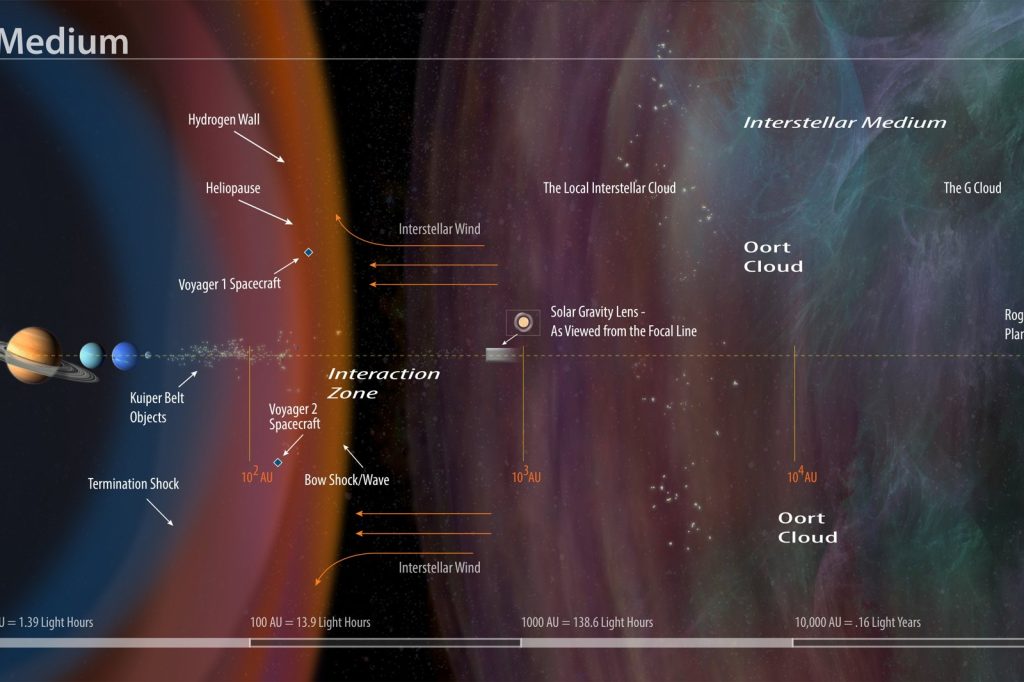
MANILA, July 9 — For generations, the idea of leaving our solar system felt like the stuff of science fiction. But right now, at the very edge of the Sun’s influence, a boundary known as the heliopause is being crossed by human-made spacecraft, giving scientists their first real look at what lies beyond.
The heliopause is the invisible frontier where the solar wind — that constant stream of charged particles flowing from our Sun — finally meets the interstellar medium, the vast matter and radiation that fills the space between stars. Think of it as the outermost bubble of our Sun’s influence, a region called the heliosphere that extends far beyond the orbit of Pluto.
This boundary isn’t a fixed wall. According to data from NASA’s Interstellar Boundary Explorer (IBEX), launched in 2008, the heliopause’s distance from the Sun shifts depending on solar activity and the direction of interstellar flow. It varies from about 80 to 120 AU — with one astronomical unit being the distance from Earth to the Sun.
Inside this bubble lies the heliosheath, where the solar wind slows down and heats up. The first dramatic slowdown, called the termination shock, happens closer in, at about 75 to 90 AU.
What makes this boundary so significant for communities across Asia and the world is what it represents. Crossing the heliopause means leaving the Sun’s backyard and entering the galaxy proper. Beyond it, the interstellar medium has a higher density of neutral atoms and a completely different magnetic field orientation.
It is, quite literally, the edge of our cosmic home. The Voyager 1 and Voyager 2 spacecraft have already made this historic crossing, providing the first in-situ data from beyond the heliopause. Now, New Horizons — the spacecraft that gave us our first close-up look at Pluto — is set to provide the third direct crossing.
This will complement the Voyager data, giving scientists a fuller picture of this mysterious boundary. For people across the Philippines and the broader region, this research might seem distant.
But the technology that maps the heliopause — detecting energetic neutral atoms — is the same kind of innovation that drives advances in satellite communications, weather forecasting, and even the navigation systems we use every day. When scientists understand the environment our solar system moves through, they better understand the cosmic radiation that reaches Earth. The heliopause is the outermost layer of the Sun’s influence.
Crossing it marks entry into the galaxy proper. As New Horizons continues its journey, it will provide the third in-situ crossing, complementing Voyager data.
For a region that looks to the stars with wonder, this is a reminder that exploration is not just about distant places — it is about understanding the very space we all inhabit.