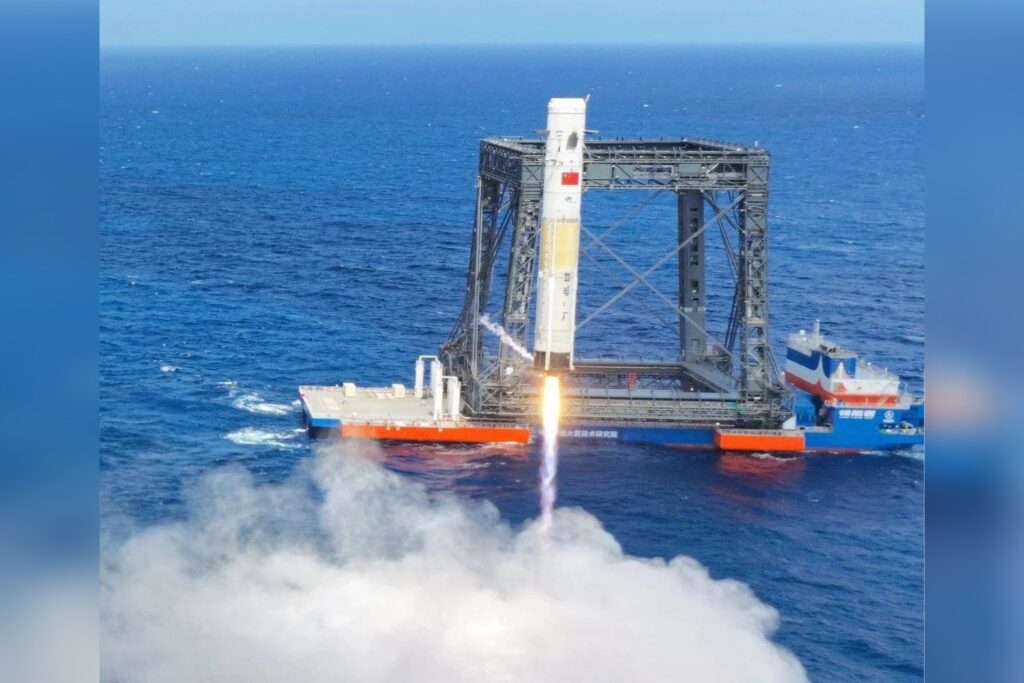
Cost Targets and Market Competition
The China Aerospace Science and Technology Corporation (CASC) has set a goal of cutting costs by 30 percent per launch. If achieved, that would bring the price to approximately $10,500 per kilogram. That figure remains higher than SpaceX’s Falcon 9, which launches at about $2,700 per kilogram, and far above SpaceX’s stated target of under $1,000 per kilogram for its Starship system. Nonetheless, the Long March 10 series has a development cost of $2.8 billion — a fraction of the $10 billion estimated for SpaceX’s Starship program. China’s overall space budget in 2024 was roughly $15 billion, according to the OECD.
The cost gap between China and SpaceX remains substantial. But the Long March 10B’s successful recovery demonstrates that the underlying technology works, positioning China to increase its launch frequency from 67 launches in 2023 to more than 100 annually by 2026, driven by reusable rockets. The move by a large manufacturing state into reusable launch technology widens the field of suppliers in a market that has long been shaped by a small number of actors. Readers may see changed launch prices and faster deployment of satellite systems as a result.
Dual-Use Technology and Satellite Internet Ambitions
Beyond commercial launches, the reusable rocket capability directly supports China’s Guowang project, a satellite internet constellation that plans to deploy 13,000 satellites by 2030. The dual-purpose nature of the technology means that cost reductions achieved through reusability can accelerate the build-out of China’s domestic communications infrastructure, further integrating space activities into the country’s broader industrial weight.
China is a country in East Asia governed by the Chinese Communist Party as a unitary state since the proclamation of the People’s Republic in 1949. Its shift toward a socialist market economy after 1978 brought large-scale manufacturing growth and a major global economic role. Space launch services first appeared in the late 1950s as exclusive national programs before commercial operators grew in importance later in the 20th century. Competition among launch providers then began to reflect market forces more than political ties of manufacturer or operator. China’s space activities now sit inside that broader industrial weight, and the entry of a reusable Chinese booster into the market represents a further step in that evolution.
Implications for the Global Launch Landscape
The successful test flight of the Long March 10B does not immediately close the cost gap with established players like SpaceX, but it signals that Chinese rocket engineers have solved the fundamental technical challenge of recovering and reusing a booster. The development cost of $2.8 billion for the Long March 10 series is notably lower than comparable American programs, and China’s total space budget of about $15 billion in 2024 provides a sustained funding base.
If CASC meets its cost-reduction target of 30 percent per launch, the resulting price of $10,500 per kilogram would still exceed current SpaceX rates, but it would also represent a significant reduction from previous Chinese expendable launch prices. With launch frequency expected to rise above 100 per year by 2026, China’s share of the global market could grow in parallel. The Space Foundation’s estimate of a climb from 15 percent to 25 percent by 2030 rests on the assumption that reusable systems will enter regular service and achieve the intended savings.
For the global launch industry, the arrival of a reusable Chinese competitor broadens the set of options for satellite operators and governments seeking access to space. The cost gap with SpaceX remains wide, but the technology now works, and the scale of China’s manufacturing base and budget suggests that the competitive dynamics of the commercial launch market will continue to shift in the years ahead.
Sources
- China tests Long March-10 rocket with 990-ton thrust for moon mission
- China's Long March-10 rocket passes key test for lunar missions